
CBSE Class 10 Science Notes – Life Processes

1. Introduction
Life processes are the basic functions performed by living organisms to maintain life. These include nutrition, respiration, transportation, and excretion. All living organisms need energy to perform various life activities, and this energy comes from food through the process of nutrition.
- To obtain and utilize energy for metabolic activities
- To maintain body organization and repair damaged tissues
- To remove waste products from the body
- To maintain homeostasis (stable internal environment)
- To support growth and reproduction
- Board Exam Weightage: 8-10 marks (Theory + Practical)
- Highest weightage among Biology chapters
- High-scoring: Diagrams (heart, nephron, digestive system), processes, equations
- NCERT Chapter 5: Life Processes (2024-25 Edition)
2. Chapter Overview
CBSE Class 10 Science Notes for this chapter cover four main life processes:
- Nutrition: Autotrophic and heterotrophic nutrition, photosynthesis, human digestive system
- Respiration: Aerobic and anaerobic respiration, breathing vs respiration, ATP formation
- Transportation: In humans (heart, blood, blood vessels, double circulation) and plants (xylem, phloem, transpiration)
- Excretion: Human excretory system, nephron structure and function, urine formation, excretion in plants
3. CBSE Class 10 Science Notes – Nutrition
Autotrophic Nutrition (Photosynthesis)
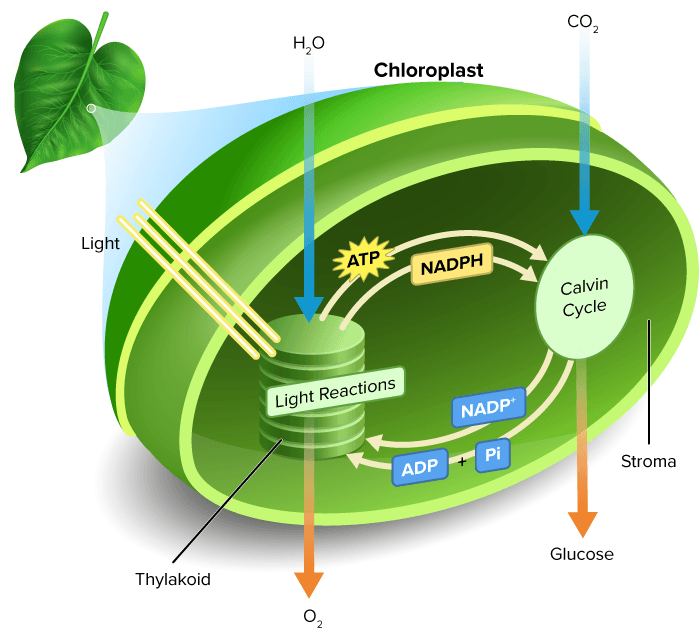
Autotrophic nutrition is the mode of nutrition in which organisms synthesize their own food from simple inorganic substances like CO₂ and H₂O using sunlight energy. This process is called photosynthesis and occurs in green plants, algae, and some bacteria.
Carbon dioxide + Water → Glucose + Oxygen
Raw Materials for Photosynthesis:
- Carbon dioxide: Enters through stomata in leaves
- Water: Absorbed by roots from soil, transported through xylem
- Sunlight: Captured by chlorophyll in chloroplasts
- Chlorophyll: Green pigment present in chloroplasts
Events During Photosynthesis:
- Absorption of light energy by chlorophyll
- Conversion of light energy to chemical energy and splitting of water molecules into hydrogen and oxygen
- Reduction of carbon dioxide to carbohydrates (glucose) using hydrogen
- Stomata are tiny pores on leaf surface for gaseous exchange
- Guard cells control opening and closing of stomata
- When water flows into guard cells → they swell → stomata open
- When water flows out → they shrink → stomata close
- Stomata close at night to prevent water loss
Heterotrophic Nutrition
Organisms that cannot synthesize their own food and depend on other organisms for nutrition.
Types of Heterotrophic Nutrition:
| Type | Description | Examples |
|---|---|---|
| Holozoic | Ingestion of complex food, internal digestion | Humans, amoeba, cow |
| Saprophytic | Feeding on dead and decaying organic matter | Fungi (mushroom), bacteria |
| Parasitic | Obtaining nutrition from living host | Cuscuta (plant), tapeworm, lice |
Nutrition in Amoeba (Holozoic Nutrition):
- Ingestion: Food engulfed by pseudopodia forming food vacuole
- Digestion: Food broken down by enzymes in food vacuole
- Absorption: Digested food absorbed into cytoplasm
- Assimilation: Food used for energy, growth, and repair
- Egestion: Undigested food expelled out
Human Digestive System
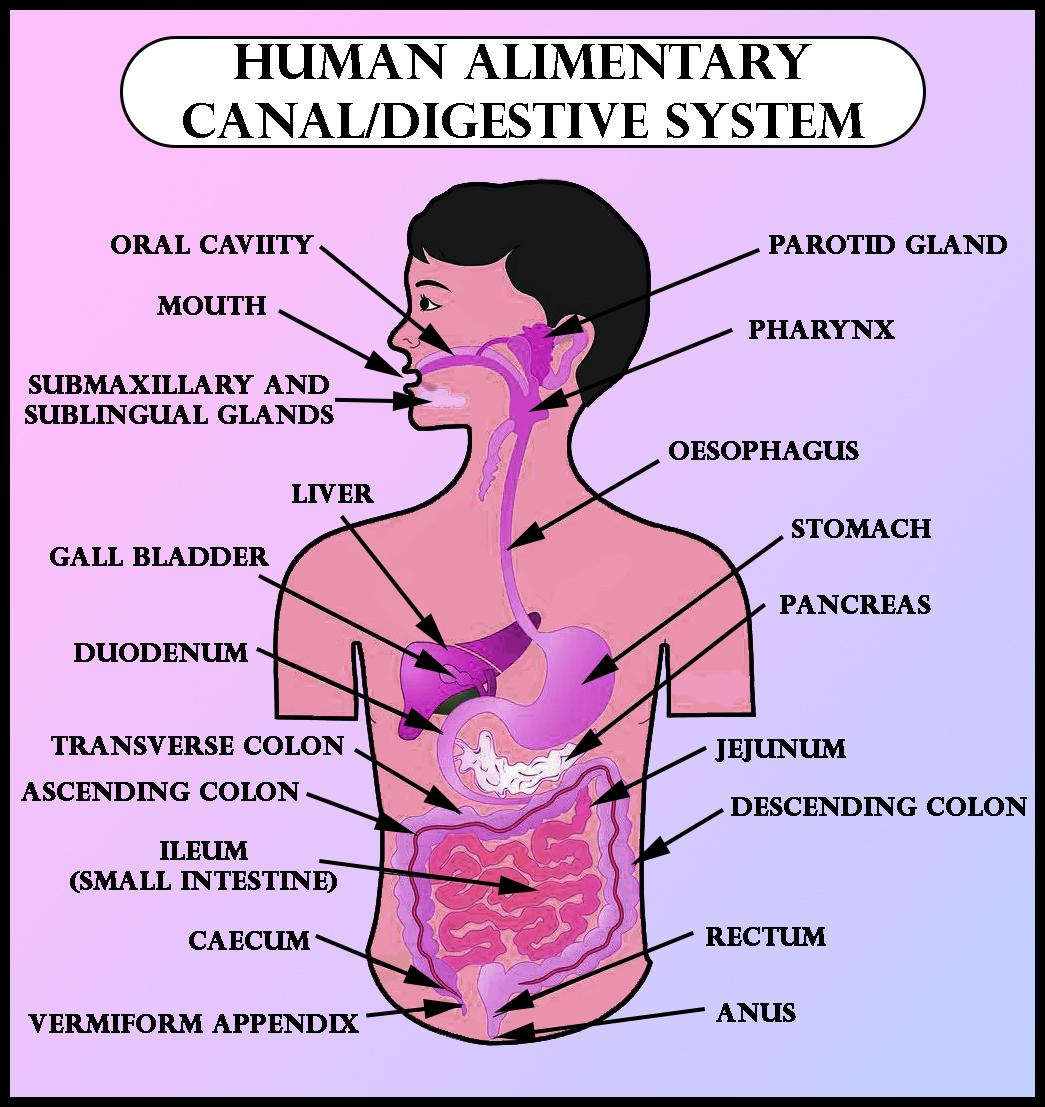
The digestive system consists of the alimentary canal and associated glands.
Parts of the Alimentary Canal:
- Mouth: Food ingestion, mechanical digestion by teeth, chemical digestion by saliva (salivary amylase converts starch to maltose)
- Oesophagus: Transports food to stomach by peristalsis
- Stomach: Gastric glands secrete gastric juice (HCl, pepsin, mucus). HCl kills bacteria and provides acidic pH. Pepsin digests proteins.
- Small intestine: Longest part (about 6 meters). Receives bile from liver and pancreatic juice from pancreas. Complete digestion and absorption occur here.
- Large intestine: Absorbs water and minerals. Forms and stores faeces.
- Anus: Egestion of undigested waste
Associated Glands:
- Salivary glands: Secrete saliva containing amylase
- Liver: Produces bile (stored in gall bladder) which emulsifies fats
- Pancreas: Secretes pancreatic juice with enzymes (trypsin, lipase, amylase)
4. CBSE Class 10 Science Notes – Respiration
What is Respiration?
Respiration is the process of breakdown of glucose (food) to release energy in the form of ATP. This energy is used for various life activities.
Steps of Respiration:
- Glycolysis: Glucose (6C) → Pyruvate (3C) in cytoplasm
- Breakdown of pyruvate: In presence or absence of oxygen
Aerobic Respiration
Takes place in the presence of oxygen in mitochondria. Complete breakdown of glucose occurs.
Glucose + Oxygen → Carbon dioxide + Water + Energy
Anaerobic Respiration
Takes place in the absence of oxygen in cytoplasm. Incomplete breakdown of glucose occurs.
In Yeast (Fermentation):
Glucose → Ethanol + Carbon dioxide + Energy
In Human Muscles (During vigorous exercise):
Glucose → Lactic acid + Energy
Result: Accumulation of lactic acid causes muscle cramps
Difference Between Breathing and Respiration
| Breathing | Respiration |
|---|---|
| Physical process | Chemical process |
| Involves inhalation and exhalation of air | Involves breakdown of glucose to release energy |
| No energy released | Energy released in form of ATP |
| Occurs in respiratory organs | Occurs in all living cells |
Human Respiratory System
- Nasal passage: Filters, warms, and moistens air
- Trachea (Windpipe): Supported by C-shaped cartilage rings
- Bronchi: Two branches of trachea entering lungs
- Bronchioles: Smaller branches of bronchi
- Alveoli: Air sacs where gaseous exchange occurs
- Thin, moist walls (one cell thick)
- Large surface area (about 80 m² in humans)
- Rich blood supply
- Close proximity to capillaries
5. CBSE Class 10 Science Notes – Transportation
Transportation in Humans
The circulatory system consists of heart, blood, and blood vessels.
Human Heart
- Muscular organ about the size of a fist
- Located in the chest cavity, slightly tilted to the left
- Has four chambers: two upper atria and two lower ventricles
- Right side carries deoxygenated blood, left side carries oxygenated blood
- Septum separates right and left sides preventing mixing of blood
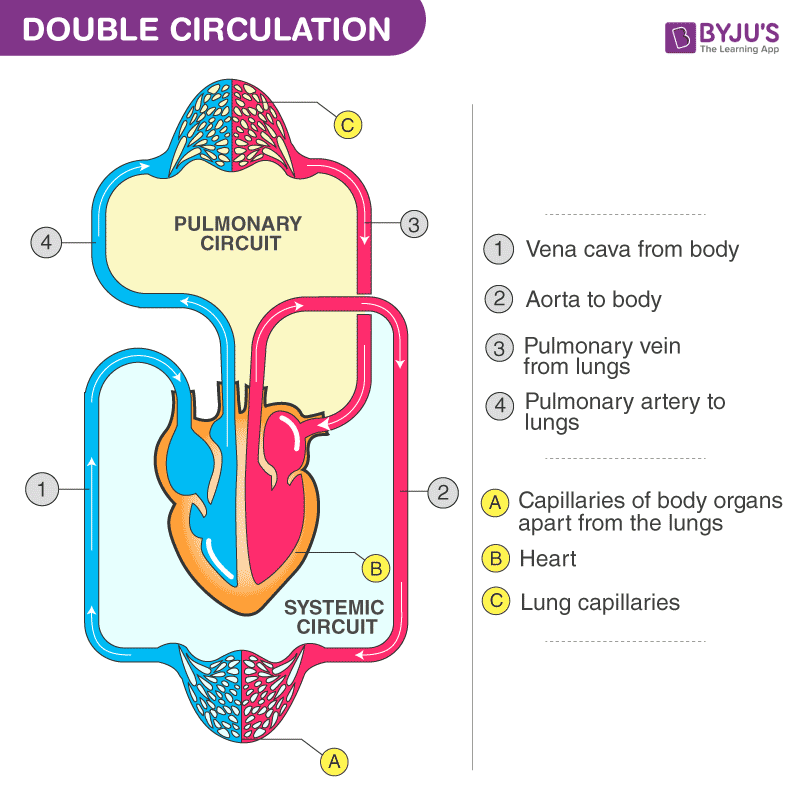
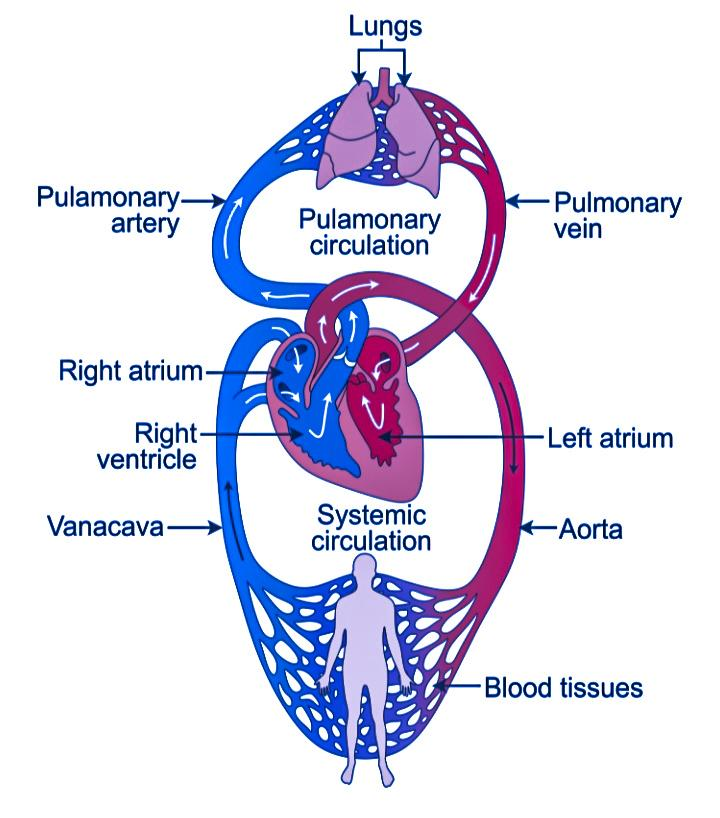
Double Circulation
Blood passes through the heart twice in one complete cycle:
1. Pulmonary Circulation (Heart → Lungs → Heart):
- Right ventricle pumps deoxygenated blood to lungs through pulmonary artery
- In lungs, CO₂ is released and O₂ is absorbed
- Oxygenated blood returns to left atrium through pulmonary veins
2. Systemic Circulation (Heart → Body → Heart):
- Left ventricle pumps oxygenated blood to all body parts through aorta
- O₂ is delivered and CO₂ is collected from tissues
- Deoxygenated blood returns to right atrium through vena cava
- Keeps oxygenated and deoxygenated blood completely separate
- Ensures efficient oxygen supply to body tissues
- Maintains higher blood pressure for faster blood flow
- Supports high metabolic rate required by warm-blooded animals
Blood Components
| Component | Function |
|---|---|
| Plasma (55%) | Transports nutrients, hormones, waste; maintains osmotic pressure |
| RBC (Erythrocytes) | Contains haemoglobin; transports oxygen |
| WBC (Leucocytes) | Fight infections; immunity |
| Platelets (Thrombocytes) | Blood clotting |
Transportation in Plants
Xylem
- Transports water and minerals from roots to aerial parts
- Made of tracheids and vessels (dead cells)
- Transport is unidirectional (upward only)
- Mainly driven by transpiration pull
Phloem
- Transports food (sucrose, amino acids) from leaves to other parts
- Made of sieve tubes and companion cells (living cells)
- Transport is bidirectional (upward and downward)
- Requires energy (ATP) - called translocation
Transpiration
Loss of water vapor from aerial parts of plant, mainly through stomata.
Significance:
- Creates transpiration pull for upward movement of water
- Cools the plant
- Helps in absorption and distribution of minerals
- Maintains cell turgidity
6. CBSE Class 10 Science Notes – Excretion
Human Excretory System
Organs involved: Pair of kidneys, pair of ureters, urinary bladder, urethra.
Kidneys
- Bean-shaped organs located at the back of abdomen
- Basic filtration unit is nephron
- Each kidney contains about 1 million nephrons
Nephron Structure and Function
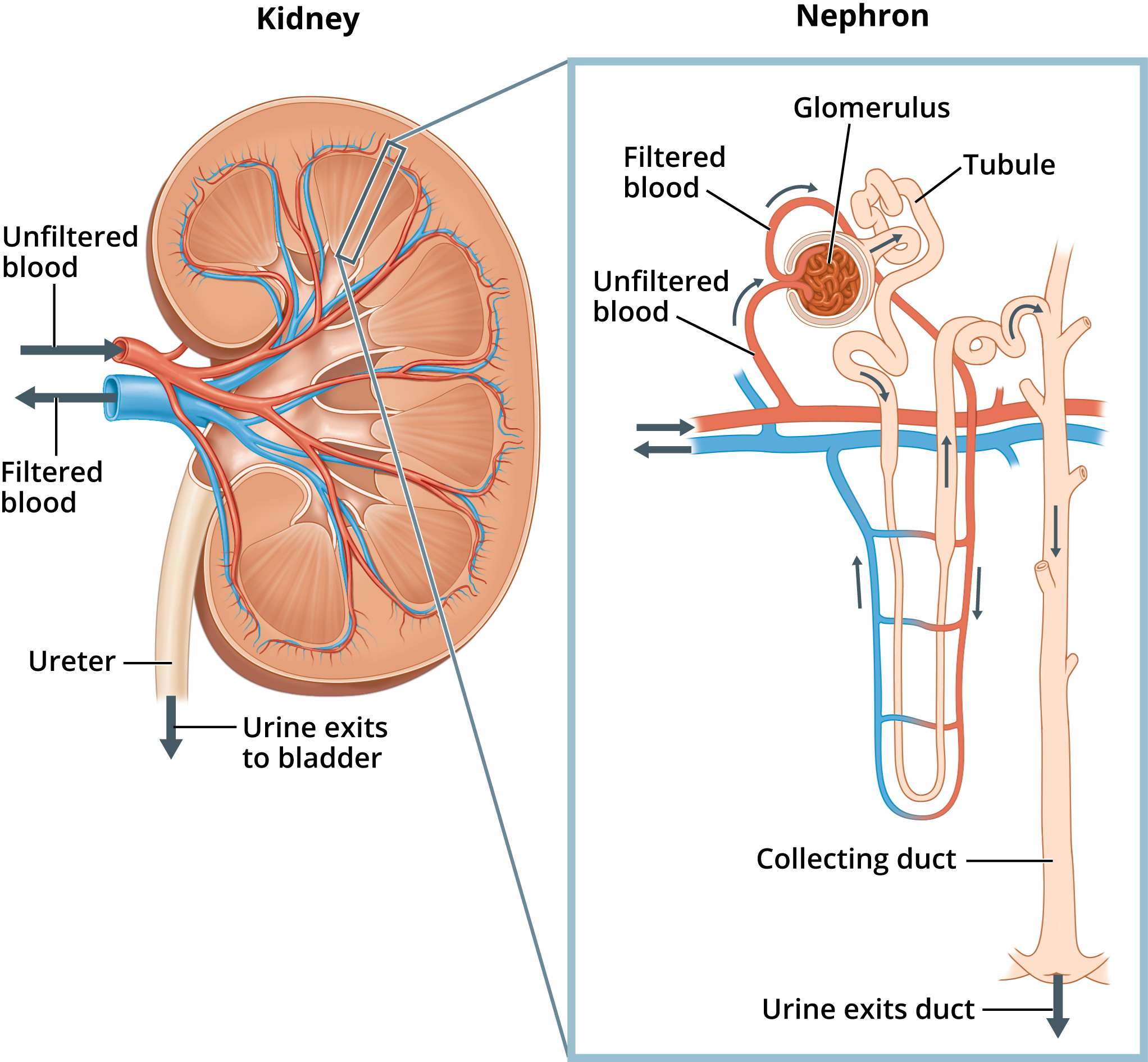
Nephron is the structural and functional unit of kidney.
Parts of Nephron:
- Bowman's Capsule: Cup-shaped structure enclosing glomerulus
- Glomerulus: Network of capillaries for blood filtration
- Proximal Convoluted Tubule (PCT): Reabsorption of glucose, amino acids, water
- Loop of Henle: Concentration of urine
- Distal Convoluted Tubule (DCT): Selective reabsorption and secretion
- Collecting Duct: Collects urine from nephrons
Urine Formation Steps
- Filtration: Blood is filtered in glomerulus; filtrate contains water, glucose, salts, urea
- Reabsorption: Useful substances (glucose, amino acids, most water) reabsorbed into blood
- Secretion: Some waste substances secreted from blood into tubule
- Concentration: Water reabsorbed according to body's need; concentrated urine formed
Excretion in Plants
Plants use different strategies for excretion:
- Oxygen: Released during photosynthesis (waste product of photosynthesis)
- CO₂: Released during respiration
- Water: Lost through transpiration and guttation
- Other wastes: Stored in vacuoles, bark, or leaves that fall off
- Resins and gums: Stored in old xylem
7. Important Points (Quick Revision)
- Photosynthesis: 6CO₂ + 6H₂O → C₆H₁₂O₆ + 6O₂ (sunlight, chlorophyll)
- Aerobic Respiration: C₆H₁₂O₆ + 6O₂ → 6CO₂ + 6H₂O + 38 ATP
- Anaerobic Respiration in Yeast: C₆H₁₂O₆ → 2C₂H₅OH + 2CO₂ + 2 ATP
- Double Circulation: Pulmonary (heart-lungs-heart) + Systemic (heart-body-heart)
- Xylem: Water and minerals, unidirectional, dead cells
- Phloem: Food transport, bidirectional, living cells
- Nephron: Filtration → Reabsorption → Secretion → Concentration
- Haemoglobin deficiency: Causes anaemia, reduced oxygen carrying capacity
8. Solved Examples (CBSE Pattern)
Example 1: Photosynthesis Explanation (3 Marks)
Question: Write the equation for photosynthesis. Name the raw materials required and products formed.
Equation:
Raw Materials: Carbon dioxide (from air through stomata), Water (from soil through roots)
Products: Glucose (food), Oxygen (released into air)
Example 2: Difference Between Aerobic and Anaerobic Respiration (3 Marks)
Question: Differentiate between aerobic and anaerobic respiration. Name two organisms that undergo anaerobic respiration.
| Aerobic Respiration | Anaerobic Respiration |
|---|---|
| Occurs in presence of oxygen | Occurs in absence of oxygen |
| Complete breakdown of glucose | Incomplete breakdown of glucose |
| More energy (38 ATP) | Less energy (2 ATP) |
| Products: CO₂ + H₂O | Products: Ethanol + CO₂ or Lactic acid |
Organisms: Yeast, some bacteria, human muscle cells (during vigorous exercise)
Example 3: Diagram-Based Question (3 Marks)
Question: Draw a labelled diagram of the human heart and explain double circulation.
Double Circulation Explanation:
- Pulmonary Circulation: Right ventricle → Pulmonary artery → Lungs → Pulmonary vein → Left atrium
- Systemic Circulation: Left ventricle → Aorta → Body parts → Vena cava → Right atrium
Significance: Keeps oxygenated and deoxygenated blood separate; ensures efficient oxygen supply.
Example 4: 5-Mark Conceptual Question
Question: a) Describe the structure and functioning of nephrons.
b) What are the methods used by plants to get rid of excretory products?
a) Nephron Structure and Function:
Structure: Nephron consists of Bowman's capsule (encloses glomerulus), proximal convoluted tubule, loop of Henle, distal convoluted tubule, and collecting duct.
Function:
- Filtration: Blood filtered in glomerulus; filtrate enters Bowman's capsule
- Reabsorption: Useful substances (glucose, amino acids, water) reabsorbed in PCT and DCT
- Secretion: Waste substances secreted from blood into tubule
- Urine formation: Concentrated urine collected in collecting duct
b) Excretion in Plants:
- Oxygen released during photosynthesis
- CO₂ released during respiration
- Water lost through transpiration
- Wastes stored in vacuoles or old xylem (resins, gums)
- Wastes stored in leaves that fall off
Example 5: Case-Study Based Question
Passage: A person was diagnosed with kidney failure. The doctor suggested dialysis or kidney transplant. The patient's blood report showed high urea levels.
Questions: a) Why does kidney failure lead to high urea levels? b) What is the principle of dialysis? c) Why is kidney transplant better than lifelong dialysis?
a) Kidneys filter urea from blood. When kidneys fail, urea is not removed and accumulates in blood.
b) Dialysis works on the principle of diffusion across a semi-permeable membrane. Blood flows on one side, dialysing fluid on other side. Waste products diffuse from blood to fluid.
c) Kidney transplant is better because: patient can lead normal life, no need for regular dialysis sessions, better quality of life, more cost-effective in long run.
9. Smart Tricks & Memory Aids
Nutrition → Respiration → Transportation → Excretion
Remember: "Nurse Ritu Treats Everyone"
6-6-6-6 Rule: 6CO₂ + 6H₂O → C₆H₁₂O₆ + 6O₂
Or: "6 Carbons, 6 Waters, 6 Oxygens out"
Right side of heart = Deoxygenated blood (both start with consonant)
Left side of heart = Oxygenated blood (both start with vowel)
Or: "Right De, Left O"
Filtration → Reabsorption → Secretion → Concentration
Remember: "FRSC" or "Famous Rivers Sing Classics"
- Always draw diagrams where asked (carry 30-40% marks)
- For processes: Write in points, not paragraphs
- Include chemical equations for photosynthesis and respiration
- Label diagrams clearly with proper spellings
- For comparison questions: Use tables
- Remember key terms: ATP, nephron, double circulation, transpiration
10. Visual Learning – Diagrams
11. Most Important Board Questions
1 Mark Questions
2-3 Mark Questions
4-5 Mark Questions
12. Common Mistakes to Avoid
| Mistake | Correction |
|---|---|
| Confusing breathing and respiration | Breathing is physical (inhalation/exhalation); Respiration is chemical (breakdown of glucose) |
| Incorrect photosynthesis equation | 6CO₂ + 6H₂O → C₆H₁₂O₆ + 6O₂ (not 12H₂O in products) |
| Incomplete heart diagram | Label all 4 chambers, major blood vessels, and septum |
| Mixing xylem and phloem | Xylem = water, unidirectional; Phloem = food, bidirectional |
| Wrong blood vessels | Pulmonary artery carries deoxygenated blood (exception); Pulmonary vein carries oxygenated blood (exception) |
13. Practice Section
Multiple Choice Questions (MCQs)
Q1. The process of photosynthesis occurs in which organelle?
- Mitochondria
- Chloroplast
- Ribosome
- Nucleus
Q2. Which of the following is the correct path of urine formation?
- Filtration → Secretion → Reabsorption
- Filtration → Reabsorption → Secretion
- Reabsorption → Filtration → Secretion
- Secretion → Filtration → Reabsorption
Q3. The breakdown of pyruvate in presence of oxygen takes place in:
- Cytoplasm
- Mitochondria
- Nucleus
- Chloroplast
Assertion-Reason Question
Assertion (A): The walls of alveoli are one cell thick.
Reason (R): Thin walls facilitate efficient exchange of gases.
Answer: Both A and R are true and R is the correct explanation of A.
Explanation: Thin walls (one cell thick) and rich blood supply in alveoli allow rapid diffusion of gases.
14. Frequently Asked Questions (FAQ)
15. Conclusion
Master Life Processes for Board Success!
These comprehensive CBSE Class 10 Notes for "Life Processes" cover all essential concepts, diagrams, and solved examples to help you excel in your board examinations.
Key Takeaways:
- Master photosynthesis and respiration equations
- Practice drawing heart and nephron diagrams
- Understand double circulation thoroughly
- Remember differences between xylem and phloem
- Know the steps of urine formation
Next Chapter: Control and Coordination – CBSE Class 10 Notes
Best of luck for your CBSE Class 10 Board Examinations!
These CBSE Class 10 Science Notes are prepared by experienced Biology faculty following the latest NCERT curriculum.