
CBSE Class 10 Maths Notes – Chapter 1: Real Numbers

1. Introduction to Real Numbers
Welcome to your comprehensive CBSE Class 10 Notes for Mathematics Chapter 1 - Real Numbers. This foundational chapter introduces you to the number system and its properties, carrying approximately 6-8 marks in the CBSE Board Examination.
What are Real Numbers?
Real Numbers comprise all rational and irrational numbers. They can be represented on the number line and include:
- Natural Numbers (N): 1, 2, 3, 4, ...
- Whole Numbers (W): 0, 1, 2, 3, ...
- Integers (Z): ..., -2, -1, 0, 1, 2, ...
- Rational Numbers (Q): Numbers of form p/q where q ≠ 0
- Irrational Numbers: Numbers that cannot be expressed as p/q
These CBSE Class 10 Maths Notes are strictly aligned with the latest NCERT syllabus (2024-25) and designed to help you master every concept from Euclid's Division Lemma to decimal expansions.
2. Chapter Overview: CBSE Class 10 Maths Notes
Key Topics Covered:
- Euclid's Division Lemma – Foundation of division algorithm
- Euclid's Division Algorithm – Method to find HCF
- Fundamental Theorem of Arithmetic – Prime factorization uniqueness
- HCF and LCM – Using prime factorization method
- Irrational Numbers – Properties and proofs
- Decimal Expansion of Rational Numbers – Terminating vs non-terminating
3. Key Concepts (NCERT Aligned)
3.1 Euclid's Division Lemma
Statement:
Given any two positive integers a and b, there exist unique integers q (quotient) and r (remainder) such that:
Conditions:
- a = Dividend (any positive integer)
- b = Divisor (positive integer, b ≠ 0)
- q = Quotient (unique integer)
- r = Remainder (unique integer, 0 ≤ r < b)
Key Points:
- If r = 0, then b is a divisor of a (b divides a exactly)
- The remainder is always less than the divisor (r < b)
- This lemma forms the basis of the Division Algorithm
3.2 Euclid's Division Algorithm
Definition: A technique to compute the Highest Common Factor (HCF) of two positive integers using Euclid's Division Lemma repeatedly.
Steps to find HCF using Euclid's Division Algorithm:
a = bq + r, where 0 ≤ r < b
If r ≠ 0, apply the lemma again to b and r.
The divisor at this stage will be the required HCF.
Example: Find HCF of 420 and 130
Step 2: 130 = 30 × 4 + 10
Step 3: 30 = 10 × 3 + 0
HCF = 10 (last non-zero remainder)
3.3 Fundamental Theorem of Arithmetic
Statement:
Every composite number greater than 1 can be expressed as a product of prime numbers, and this factorization is unique apart from the order in which the prime factors occur.
Key Points:
- Also known as the Unique Factorization Theorem
- Prime factorization of a number is unique (except for the order of factors)
- Example: 420 = 2² × 3 × 5 × 7 (only one way to express as product of primes)
3.4 HCF and LCM using Prime Factorization
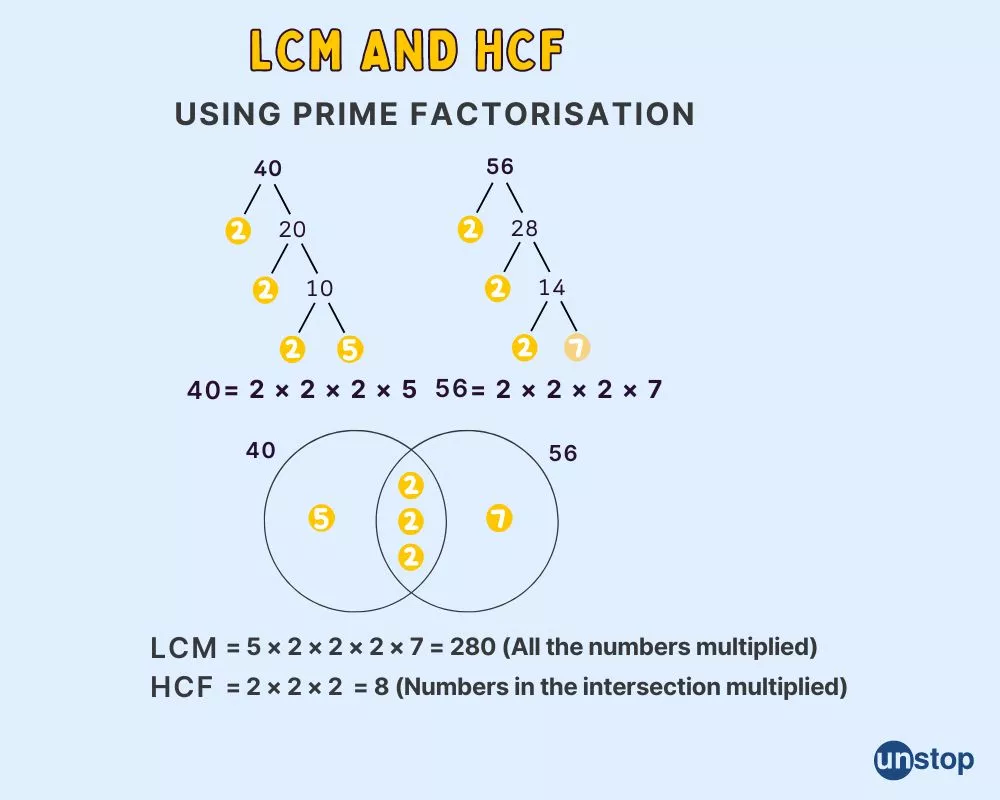
Method to find HCF:
- Express each number as product of prime factors
- Identify common prime factors
- Take the lowest power of each common prime factor
- Multiply these together to get HCF
Method to find LCM:
- Express each number as product of prime factors
- Take all prime factors (common and uncommon)
- Take the highest power of each prime factor
- Multiply these together to get LCM
Important Relationship:
(For any two positive integers a and b)
Example: Find HCF and LCM of 36 and 48
48 = 2⁴ × 3¹
HCF = 2² × 3¹ = 4 × 3 = 12
LCM = 2⁴ × 3² = 16 × 9 = 144
Verification: 12 × 144 = 1728 = 36 × 48 ✓
3.5 Irrational Numbers
Definition: Numbers that cannot be expressed in the form p/q where p and q are integers and q ≠ 0. Their decimal expansions are non-terminating and non-repeating.
Examples: √2, √3, √5, π, e, 0.1010010001...
Theorem: If p is a prime number, then √p is irrational.
Proof that √5 is irrational (Contradiction Method):
Step 1: Assume √5 is rational.
Then √5 = ab where a, b are co-prime integers (HCF = 1) and b ≠ 0.
Step 2: Squaring both sides:
5 = a²b²
⇒ a² = 5b² ... (i)
Step 3: From (i), a² is divisible by 5.
⇒ a is divisible by 5 (since 5 is prime)
Let a = 5c for some integer c.
Step 4: Substituting in (i):
(5c)² = 5b²
25c² = 5b²
5c² = b²
Step 5: From above, b² is divisible by 5.
⇒ b is divisible by 5.
Step 6: From steps 3 and 5, both a and b are divisible by 5.
This contradicts our assumption that a and b are co-prime.
Conclusion: Our assumption is wrong. Therefore, √5 is irrational.
3.6 Decimal Expansion of Rational Numbers
Theorem: Let x be a rational number whose decimal expansion terminates. Then x can be expressed in the form pq where p and q are co-prime, and the prime factorization of q is of the form 2n × 5m, where n and m are non-negative integers.
Condition for Terminating Decimal:
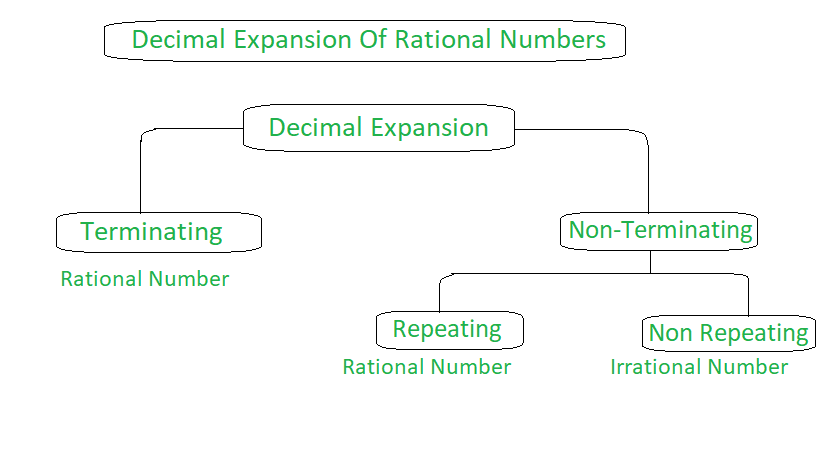
A rational number pq (in lowest terms) has a terminating decimal expansion if and only if the prime factorization of q is of the form 2n × 5m.
If q has any prime factor other than 2 or 5, the decimal expansion is non-terminating repeating.
Examples:
| Number | Prime Factorization of Denominator | Type of Decimal | Decimal Value |
|---|---|---|---|
| 38 | 8 = 2³ | Terminating | 0.375 |
| 720 | 20 = 2² × 5 | Terminating | 0.35 |
| 13 | 3 = 3¹ | Non-terminating repeating | 0.333... |
| 56 | 6 = 2 × 3 | Non-terminating repeating | 0.8333... |
4. Important Formulas and Results
Essential Formulas for CBSE Class 10 Maths Notes
1. Euclid's Division Lemma:
Use when: Finding relationship between dividend, divisor, quotient and remainder
2. HCF and LCM Relationship:
Use when: Finding LCM when HCF is known, or vice versa
3. Terminating Decimal Condition:
Use when: Determining if a fraction will have terminating or repeating decimal
4. Prime Factorization Steps:
- Divide by smallest prime (2) until odd
- Then divide by 3, 5, 7, ... successively
- Continue until quotient becomes 1
5. Solved Examples (CBSE Pattern)
Question: Find the HCF of 867 and 255 using Euclid's Division Algorithm.
Step 1: 867 = 255 × 3 + 102
Step 2: 255 = 102 × 2 + 51
Step 3: 102 = 51 × 2 + 0
Since remainder is 0, the divisor at this step is the HCF.
Therefore, HCF(867, 255) = 51
Question: Find the HCF and LCM of 72, 120, and 168.
Prime Factorization:
72 = 2³ × 3²
120 = 2³ × 3 × 5
168 = 2³ × 3 × 7
HCF: Take lowest power of common primes
HCF = 2³ × 3 = 8 × 3 = 24
LCM: Take highest power of all primes
LCM = 2³ × 3² × 5 × 7 = 8 × 9 × 5 × 7 = 2520
Question: Without performing long division, determine whether the following rational numbers have terminating or non-terminating repeating decimal expansions:
(i) 13125 (ii) 178 (iii) 775
(i) 13125:
125 = 5³ = 2⁰ × 5³
Since denominator is of form 2n × 5m, decimal expansion is terminating.
(ii) 178:
8 = 2³ = 2³ × 5⁰
Since denominator is of form 2n × 5m, decimal expansion is terminating.
(iii) 775:
75 = 3 × 25 = 3 × 5²
Since denominator contains prime factor 3 (other than 2 and 5), decimal expansion is non-terminating repeating.
Question: Prove that 3 + 2√5 is irrational.
Step 1: Assume 3 + 2√5 is rational.
Step 2: Then 3 + 2√5 = ab where a, b are co-prime integers, b ≠ 0.
Step 3: Rearranging:
2√5 = ab - 3 = a - 3bb
√5 = a - 3b2b
Step 4: Since a and b are integers, a - 3b2b is rational.
This implies √5 is rational.
Step 5: But this contradicts the fact that √5 is irrational.
Conclusion: Our assumption is wrong. Therefore, 3 + 2√5 is irrational.
Question: The HCF of two numbers is 23 and their LCM is 1449. If one of the numbers is 161, find the other number.
Given:
HCF = 23
LCM = 1449
First number (a) = 161
Let second number = b
Using the formula:
HCF × LCM = a × b
23 × 1449 = 161 × b
33327 = 161 × b
b = 33327161 = 207
Therefore, the other number is 207.
6. Smart Tricks and Memory Aids
Quick HCF Trick
For two consecutive integers, HCF is always 1.
For two consecutive even integers, HCF is always 2.
For two consecutive odd integers, HCF is always 1.
Decimal Expansion Quick-Check Trick
Look at the denominator (in lowest terms):
- If it ends in 0, 2, 4, 5, 6, 8 → Check if only 2 and 5 are prime factors
- If it ends in 1, 3, 7, 9 → Likely non-terminating (check for other factors)
- Shortcut: If denominator = 2n × 5m, decimal terminates
Proof Writing Presentation Trick
Always structure irrational proofs in 6 steps:
- Assume number is rational (= p/q)
- Manipulate to isolate irrational part
- Show the other side is rational
- Conclude irrational part is rational
- State the contradiction
- Conclude original assumption is false
Time-Saving Board Strategy
- Always write the statement of theorem before solving
- For HCF by Euclid's algorithm, show each step clearly
- In prime factorization, use division method for speed
- For terminating decimal questions, don't actually divide - just check denominator
- Box your final answer for visibility
7. Visual Learning: Important Diagrams
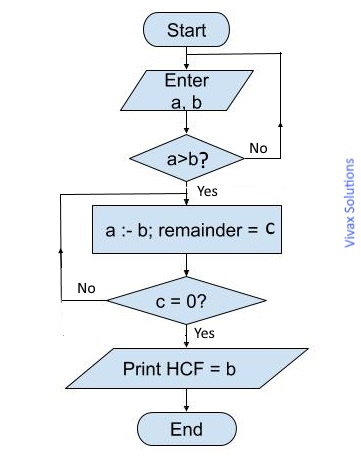
Diagram 1: Euclid's Division Algorithm Flowchart
Key Steps in Flowchart:
- Start with two numbers a and b (a > b)
- Apply division: a = bq + r
- Check if r = 0
- If yes, b is HCF
- If no, replace a with b, b with r, and repeat
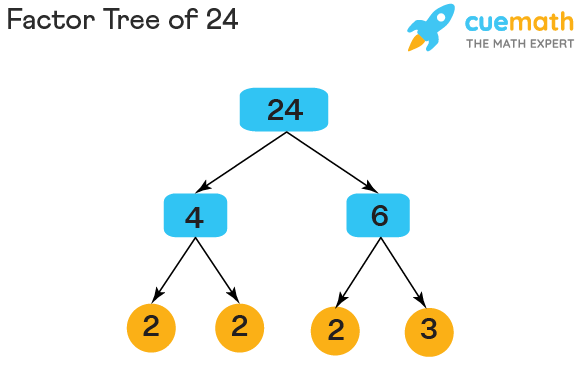
Diagram 2: Prime Factorization Tree
How to use Factor Tree:
- Write the number at top
- Break into any two factors
- Continue breaking composite factors
- Stop when all factors are prime
- Multiply all prime factors at the end
Diagram 3: Decimal Expansion Classification
Diagram 4: HCF and LCM by Prime Factorization
8. Most Important Board Questions
1 Mark Questions (Very Short Answer)
Ans: For any two positive integers a and b, there exist unique integers q and r such that a = bq + r, where 0 ≤ r < b.
Ans: 1
Ans: In the rational number p/q (in lowest terms), the prime factorization of q must be of the form 2n × 5m, where n and m are non-negative integers.
Ans: HCF × LCM = 26 × 169
13 × LCM = 4394
LCM = 338
Ans: Yes, because 7 × 11 × 13 + 11 = 11(7 × 13 + 1) = 11 × 92, which has factors other than 1 and itself.
2-3 Mark Questions (Short Answer)
Ans:
12576 = 4052 × 3 + 420
4052 = 420 × 9 + 272
420 = 272 × 1 + 148
272 = 148 × 1 + 124
148 = 124 × 1 + 24
124 = 24 × 5 + 4
24 = 4 × 6 + 0
HCF = 4
Ans:
510 = 2 × 3 × 5 × 17
92 = 2² × 23
HCF = 2
LCM = 2² × 3 × 5 × 17 × 23 = 23460
Verification:
LCM × HCF = 23460 × 2 = 46920
Product = 510 × 92 = 46920
LHS = RHS (Verified)
Ans:
If 6n ends with 0, it must be divisible by 5.
6n = (2 × 3)n = 2n × 3n
Prime factorization of 6n contains only 2 and 3.
It does not contain 5 as a factor.
Therefore, 6n cannot end with digit 0 for any natural number n.
4-5 Mark Questions (Long Answer/Proofs)
Ans:
Step 1: Assume √3 is rational.
Then √3 = ab where a, b are co-prime integers, b ≠ 0.
Step 2: Squaring: 3 = a²b²
⇒ a² = 3b² ... (i)
Step 3: From (i), a² is divisible by 3 ⇒ a is divisible by 3.
Let a = 3c.
Step 4: Substituting: (3c)² = 3b²
9c² = 3b²
3c² = b²
Step 5: b² is divisible by 3 ⇒ b is divisible by 3.
Step 6: Both a and b are divisible by 3, contradicting that they are co-prime.
Conclusion: √3 is irrational.
Ans:
Step 1: Assume 5 - √3 is rational = ab.
Step 2: Then √3 = 5 - ab = 5b - ab.
Step 3: Since a, b are integers, RHS is rational.
This implies √3 is rational.
Step 4: This contradicts the fact that √3 is irrational.
Conclusion: 5 - √3 is irrational.
Ans:
Find LCM of 9, 12, and 15.
9 = 3²
12 = 2² × 3
15 = 3 × 5
LCM = 2² × 3² × 5 = 4 × 9 × 5 = 180 minutes (or 3 hours)
Case-Study Based Question (CBSE Pattern)
A mathematics teacher asked students to find the HCF of two numbers 1260 and 1386. Student A used the prime factorization method, while Student B used Euclid's Division Algorithm.
(a) Find the HCF using both methods.
1260 = 2² × 3² × 5 × 7
1386 = 2 × 3² × 7 × 11
HCF = 2 × 3² × 7 = 126
Method 2 - Euclid's Algorithm:
1386 = 1260 × 1 + 126
1260 = 126 × 10 + 0
HCF = 126
(b) If the teacher wants to arrange 1260 books and 1386 pens into identical stacks, what is the maximum number of items in each stack?
Number of book stacks = 1260 ÷ 126 = 10
Number of pen stacks = 1386 ÷ 126 = 11
(c) Find the LCM of 1260 and 1386.
126 × LCM = 1260 × 1386
LCM = 1260 × 1386126 = 10 × 1386 = 13860
9. Common Mistakes to Avoid
Mistake 1: Writing Wrong Remainder Condition
- Wrong: Writing 0 < r ≤ b or r > b
- Correct: Always write 0 ≤ r < b (remainder is less than divisor, can be zero)
Mistake 2: Incorrect Prime Factorization
- Not dividing completely until all factors are prime
- Forgetting that 1 is not a prime number
- Tip: Always verify by multiplying factors to get original number
Mistake 3: Incomplete Proof Steps
- Not stating the assumption clearly
- Forgetting to mention that a and b are co-prime
- Missing the contradiction statement
- Remember: Every proof must end with a clear conclusion
Mistake 4: Not Writing Theorem Statement Properly
- Forgetting to mention "unique integers q and r"
- Missing the condition "0 ≤ r < b"
- Always quote the complete statement with all conditions
Mistake 5: Decimal Expansion Errors
- Not reducing fraction to lowest terms before checking denominator
- Forgetting that denominator must contain only 2 and 5 for terminating decimals
- Example: 720 terminates (20 = 2² × 5), but 730 doesn't (30 = 2 × 3 × 5)
10. Practice Section
MCQs (Multiple Choice Questions)
(a) 1 (b) 2 (c) 3 (d) 4
Ans: (c) 3
Explanation: 8 = 2³, so it terminates after 3 decimal places. (17/8 = 2.125)
(a) 60 (b) 54 (c) 45 (d) 90
Ans: (a) 60
Explanation: 12 × 180 = 36 × b ⇒ b = 2160/36 = 60
(a) 2 + √3 (b) √4 + √5 (c) √2 × √8 (d) √7
Ans: (c) √2 × √8
Explanation: √2 × √8 = √16 = 4, which is rational.
(a) 1 (b) 2 (c) 0 (d) undefined
Ans: (a) 1
Assertion-Reason Questions
Reason (R): For any two positive integers a and b, HCF(a, b) × LCM(a, b) = a × b.
(a) Both A and R are true and R is the correct explanation of A
(b) Both A and R are true but R is not the correct explanation of A
(c) A is true but R is false
(d) A is false but R is true
Ans: (a) Both true and R explains A
Verification: 5 × 150 = 25 × 30 ⇒ 750 = 750 ✓
Reason (R): If q = 2n × 5m where n, m are non-negative integers, then p/q is a terminating decimal.
Ans: (a) Both true and R explains A
Explanation: 3125 = 5⁵, so it satisfies the condition.
HOTS (Higher Order Thinking Skills)
Ans:
Using Euclid's algorithm:
117 = 65 × 1 + 52
65 = 52 × 1 + 13
52 = 13 × 4 + 0
HCF = 13
Given: 65m - 117 = 13
65m = 130
m = 2
Ans:
Let the three consecutive integers be n, n+1, n+2.
By Euclid's Division Lemma, n = 3q + r where 0 ≤ r < 3.
Case 1: If r = 0, then n = 3q (divisible by 3)
Case 2: If r = 1, then n+2 = 3q + 3 = 3(q+1) (divisible by 3)
Case 3: If r = 2, then n+1 = 3q + 3 = 3(q+1) (divisible by 3)
In all cases, one of the three consecutive integers is divisible by 3.
11. Frequently Asked Questions (FAQ)
Euclid's Division Lemma states that for any two positive integers a and b, there exist unique integers q (quotient) and r (remainder) such that a = bq + r, where 0 ≤ r < b. This lemma is the foundation of the division algorithm and is used to find the HCF of two numbers.
To identify if a rational number p/q has a terminating decimal expansion:
- First, reduce the fraction to its lowest terms
- Find the prime factorization of the denominator q
- If q = 2n × 5m (where n and m are whole numbers), the decimal terminates
- If q has any prime factor other than 2 or 5, the decimal is non-terminating repeating
Yes, these CBSE Class 10 Maths Notes are 100% aligned with the latest NCERT syllabus (2024-25). All theorems, proofs, and solved examples follow NCERT guidelines strictly. These notes cover every topic from Chapter 1 Real Numbers including Euclid's Division Lemma, Fundamental Theorem of Arithmetic, HCF, LCM, irrational numbers, and decimal expansions.
For any two positive integers a and b:
This relationship is very useful when you know one of HCF or LCM and need to find the other. It is also helpful in verifying your calculations.
Chapter 1 Real Numbers carries approximately 6-8 marks in the CBSE Class 10 Mathematics Board Examination. This typically includes 1-mark MCQs, 2-mark short answer questions, and 3-4 mark long answer questions including proofs.
12. What's Next: Introduction to Polynomials (Chapter 2 Preview)
13. Conclusion
Mastering Real Numbers is crucial for building a strong foundation in mathematics for your CBSE Class 10 Board Examination. This chapter introduces fundamental concepts that are essential for advanced mathematics in higher classes.
Key Takeaways from CBSE Class 10 Maths Notes:
- Master Euclid's Division Lemma and its application in finding HCF
- Understand the Fundamental Theorem of Arithmetic for prime factorization
- Practice the relationship HCF × LCM = Product of numbers
- Learn the condition for terminating decimal expansions
- Master the contradiction method for proving irrationality
- Solve all NCERT examples and exercises thoroughly
Revision Strategy:
- Revise these CBSE Class 10 Notes regularly
- Practice Euclid's Division Algorithm with different numbers
- Memorize the proofs of irrationality step-by-step
- Solve previous year board questions (at least 5 years)
- Attempt sample papers under exam conditions
- Focus on presentation in proofs and algorithms
