
CBSE Class 10 Maths Notes – Chapter 2 Introduction to Polynomials

Welcome to the most comprehensive CBSE Class 10 Notes for Mathematics Chapter 2. These CBSE Class 10 Maths Notes are meticulously crafted for board exam preparation, strictly following the NCERT curriculum. Whether you're aiming for full marks in your school exams or building a strong foundation for competitive tests, this guide covers everything from basic definitions to advanced HOTS questions.
1. Introduction
Polynomials form the backbone of algebraic mathematics and are crucial for CBSE Class 10 board examinations. This chapter introduces you to expressions involving variables and coefficients, helping you understand how to analyze, factorize, and graph polynomial functions.
- High Weightage: Carries 4-6 marks in CBSE board exams
- Foundation for Advanced Math: Essential for Class 11-12 Algebra and Calculus
- Real-world Applications: Used in physics, engineering, and economics for modeling relationships
These CBSE Class 10 Maths Notes are 100% aligned with NCERT Chapter 2 and cover all concepts prescribed by the CBSE syllabus.
2. Chapter Overview
| Aspect | Details |
|---|---|
| Topics Covered | Definition, Types, Zeroes, Coefficient Relations, Graphs |
| Marks Weightage | 4-6 marks (Board Exam) |
| Question Types | MCQs, Short Answer (2-3 marks), Long Answer (4-5 marks) |
| Difficulty Level | Easy to Moderate |
| NCERT Exercises | 2.1, 2.2, 2.3, 2.4 + Optional Exercise |
3. Key Concepts (Exam-Oriented)
Definition of a Polynomial
A polynomial in one variable x is an algebraic expression of the form:
p(x) = anxn + an-1xn-1 + ... + a1x + a0
Where:
- an, an-1, ..., a0 are real numbers (coefficients)
- n is a non-negative integer (degree)
- x is the variable
Terms and Coefficients
- Term: Each part of the polynomial separated by + or - signs
- Coefficient: The numerical factor of each term
Example: In 3x2 - 5x + 7
- Terms: 3x2, -5x, 7
- Coefficients: 3, -5, 7
Degree of a Polynomial
The highest power of the variable in the polynomial.
| Polynomial | Degree |
|---|---|
| 5 | 0 |
| 2x + 3 | 1 |
| x2 - 4x + 4 | 2 |
| x3 - 2x2 + x - 1 | 3 |
Types of Polynomials
| Type | Degree | General Form | Example |
|---|---|---|---|
| Constant | 0 | p(x) = c | p(x) = 5 |
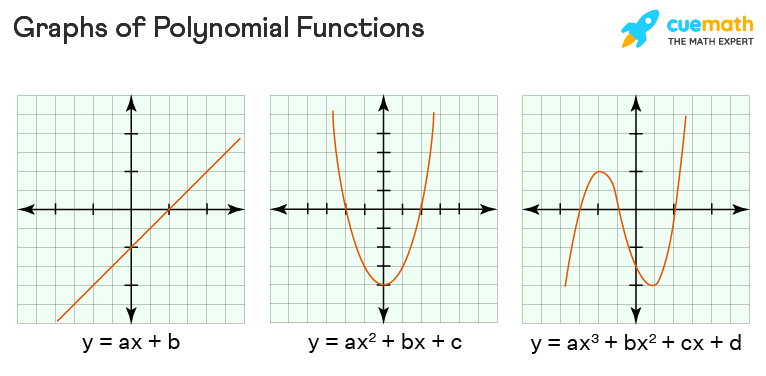
| Linear | 1 | p(x) = ax + b | p(x) = 2x + 3 |
| Quadratic | 2 | p(x) = ax2 + bx + c | p(x) = x2 - 5x + 6 |
| Cubic | 3 | p(x) = ax3 + bx2 + cx + d | p(x) = x3 - 1 |
Zeroes of a Polynomial
A real number k is a zero of polynomial p(x) if p(k) = 0.
Geometric Meaning: Zeroes are the x-coordinates where the graph of y = p(x) intersects the x-axis.
Relationship Between Zeroes and Coefficients
For Linear Polynomial ax + b:
Zero = -b/a
For Quadratic Polynomial ax2 + bx + c:
- Sum of zeroes: α + β = -b/a
- Product of zeroes: αβ = c/a
For Cubic Polynomial ax3 + bx2 + cx + d:
- Sum of zeroes: α + β + γ = -b/a
- Sum of products taken two at a time: αβ + βγ + γα = c/a
- Product of zeroes: αβγ = -d/a
4. Important Formulas
Must-Remember Formulas for CBSE Class 10 Maths Notes
| Polynomial Type | Formula | When to Use |
|---|---|---|
| Linear | Zero = -b/a | Finding the root of linear equations |
| Quadratic | Sum: α + β = -b/a | When you know coefficients and need sum of roots |
| Quadratic | Product: αβ = c/a | When you know coefficients and need product of roots |
| Quadratic Formation | x2 - (α+β)x + αβ = 0 | To form equation when zeroes are given |
Memory Trick:
- Sum = -(coefficient of x)/(coefficient of x2) → "Minus b by a"
- Product = +(constant term)/(coefficient of x2) → "c by a"
5. Solved Examples (CBSE Pattern)
Set p(x) = 0
3x - 6 = 0
3x = 6
x = 2
Answer: The zero is 2.
Step 1: Factorize the polynomial
x2 - 5x + 6 = x2 - 3x - 2x + 6
= x(x - 3) - 2(x - 3)
= (x - 3)(x - 2)
Step 2: Find zeroes
(x - 3)(x - 2) = 0
Zeroes are: α = 3 and β = 2
Step 3: Verify relationships
• Sum of zeroes: α + β = 3 + 2 = 5
• Formula check: -b/a = -(-5)/1 = 5 ✓
• Product of zeroes: αβ = 3 × 2 = 6
• Formula check: c/a = 6/1 = 6 ✓
Hence verified.
Step 1: Find sum and product of given zeroes
For 6x2 - 7x + 2:
• α + β = -b/a = 7/6
• αβ = c/a = 2/6 = 1/3
Step 2: Find sum of new zeroes
1/α + 1/β = (α + β)/(αβ) = (7/6)/(1/3) = (7/6) × 3 = 7/2
Step 3: Find product of new zeroes
(1/α) × (1/β) = 1/(αβ) = 1/(1/3) = 3
Step 4: Form new polynomial
x2 - (sum)x + (product) = 0
x2 - (7/2)x + 3 = 0
Multiply by 2 to clear fractions:
2x2 - 7x + 6 = 0
Answer: The required polynomial is 2x2 - 7x + 6 (or any non-zero multiple of it).
6. Smart Tricks Section
Quick Degree Identification Trick
Look at the highest power of x:
- No x → Degree 0 (Constant)
- x1 → Degree 1 (Linear)
- x2 → Degree 2 (Quadratic)
- x3 → Degree 3 (Cubic)
Shortcut: Ignore coefficients, just check the exponent!
Fast Zero Checking Trick
To verify if k is a zero of p(x), simply calculate p(k). If result is 0, it's a zero!
Example: Is x = 2 a zero of x3 - 8?
p(2) = 23 - 8 = 8 - 8 = 0
Yes! (Because x3 - 8 = (x-2)(x2+2x+4))
Graph Interpretation Shortcut
| Graph Behavior | Number of Zeroes |
|---|---|
| Straight line crossing x-axis once | 1 zero |
| Parabola touching x-axis at one point | 1 zero (repeated) |
| Parabola cutting x-axis at two points | 2 zeroes |
| Parabola not touching x-axis | 0 zeroes (real) |
MCQ Elimination Trick
If asked to find zeroes and options are given:
- Substitute each option into the polynomial
- The one giving zero is your answer
- Saves time in board exams!
7. Visual Learning
Graph of Linear Polynomial
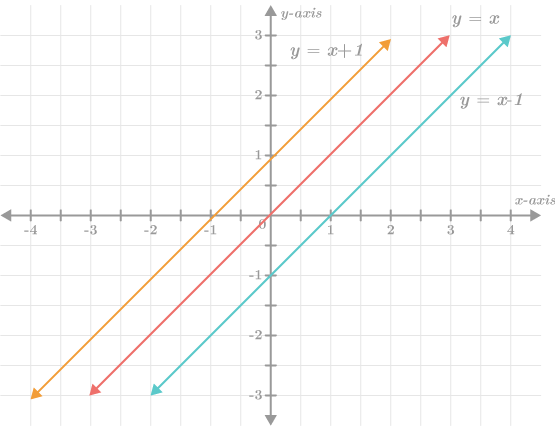
Key Points:
- Always a straight line
- Cuts x-axis at exactly one point
- General form: y = ax + b
- One real zero guaranteed
Graph of Quadratic Polynomial (Parabola)
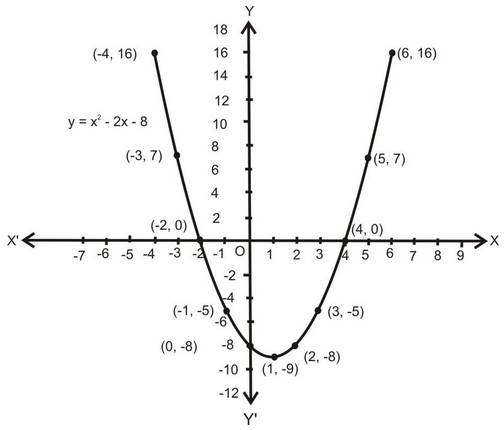
Three Cases for Zeroes:
- Two Distinct Zeroes: Parabola cuts x-axis at two different points (b2 - 4ac > 0)
- One Repeated Zero: Parabola touches x-axis at one point (b2 - 4ac = 0)
- No Real Zeroes: Parabola doesn't touch x-axis (b2 - 4ac < 0)
Comparison: Linear, Quadratic, and Cubic
8. Most Important Board Questions
★ 1 Mark Questions
Ans: 3
Ans: 4 - 10 + k = 0 ⇒ k = 6
Ans: Exactly one zero.
★★ 2-3 Mark Questions
Solution: x2 - (-3)x + 2 = x2 + 3x + 2
Solution:
α + β = 3/2
αβ = 1/2
α2 + β2 = (α+β)2 - 2αβ = 9/4 - 1 = 5/4
★★★ 4-5 Mark Proof-Based Questions
If α and β are zeroes of x2 - 6x + a and 3α + 2β = 20, find the value of a.
From polynomial: α + β = 6 and αβ = a
Given: 3α + 2β = 20
From first equation: β = 6 - α
Substitute:
3α + 2(6 - α) = 20
3α + 12 - 2α = 20
α = 8
Then β = 6 - 8 = -2
Therefore: a = αβ = 8 × (-2) = -16
Find all zeroes of 2x4 - 3x3 - 3x2 + 6x - 2 if two of its zeroes are √2 and -√2.
Since √2 and -√2 are zeroes, (x - √2)(x + √2) = x2 - 2 is a factor.
Divide the polynomial by x2 - 2 to get 2x2 - 3x + 1.
Factorize: 2x2 - 3x + 1 = (2x - 1)(x - 1)
Other zeroes: x = 1/2 and x = 1
All zeroes: √2, -√2, 1/2, 1
9. Common Mistakes Students Make
Sign Errors
Mistake: Writing sum of zeroes as b/a instead of -b/a
Correction: Always remember the minus sign for sum!
Degree Confusion
Mistake: Thinking 3x2 + 5x-1 + 2 is degree 2 polynomial
Correction: Negative powers make it not a polynomial at all!
Skipping Steps in Verification
Mistake: Directly writing "Hence verified" without showing calculations
Correction: Board examiners give marks for step-by-step verification. Always show:
- Calculate from zeroes
- Calculate from formula
- Compare both results
Writing Formula Incorrectly
Mistake: Confusing product formula with sum formula
Memory Aid:
• Sum → Starts with Sign (minus)
• Product → Positive (no sign change)
10. Practice Section
MCQs
(a) 5/2 (b) -5/2 (c) 2/5 (d) -2/5
Q2. A quadratic polynomial can have:
(a) At most 2 zeroes (b) Exactly 2 zeroes (c) At least 2 zeroes (d) 0 or 1 or 2 zeroes
Q3. If sum of zeroes is 5 and product is 6, the polynomial is:
(a) x2 + 5x + 6 (b) x2 - 5x + 6 (c) x2 - 5x - 6 (d) x2 + 5x - 6
Answers: 1-(a), 2-(d), 3-(b)
Assertion-Reason Questions
Assertion (A): The polynomial x2 + 1 has no real zeroes.
Reason (R): A quadratic polynomial always has two real zeroes.
(a) Both A and R are true and R is the correct explanation of A
(b) Both A and R are true but R is not the correct explanation of A
(c) A is true but R is false
(d) A is false but R is true
Answer: (c) A is true but R is false (A quadratic can have 0, 1, or 2 real zeroes)
Case Study Question
(i) Find the breadth of the park.
(ii) If x = 4, find the actual dimensions.
(iii) Find the zeroes of the area polynomial and interpret their meaning.
(i) Area = Length × Breadth
x2 - 5x + 6 = (x - 2)(x - 3)
So breadth = (x - 3) meters
(ii) When x = 4:
• Length = 4 - 2 = 2 meters
• Breadth = 4 - 3 = 1 meter
(iii) Zeroes are x = 2 and x = 3
• At x = 2: Breadth becomes 0 (degenerate rectangle)
• At x = 3: Length becomes 0 (degenerate rectangle)
HOTS Question
(α2/β2) + (β2/α2)
Given: α + β = p and αβ = q
(α2/β2) + (β2/α2) = (α4 + β4)/(α2β2)
= [(α2 + β2)2 - 2α2β2]/(αβ)2
= [((α+β)2 - 2αβ)2 - 2(αβ)2]/(αβ)2
= [(p2 - 2q)2 - 2q2]/q2
= [p4 - 4p2q + 4q2 - 2q2]/q2
= (p4 - 4p2q + 2q2)/q2
FAQ Section
Yes! Polynomials is one of the most scoring chapters in CBSE Class 10 Maths Notes. It carries 4-6 marks and concepts are repeatedly asked every year. The relationship between zeroes and coefficients is a favorite topic of CBSE.
To score full marks:
- Memorize all formulas perfectly (especially the sign in sum of zeroes)
- Practice NCERT examples and exercises thoroughly
- Learn to form polynomials when zeroes are given
- Master the graphical interpretation of zeroes
- Solve previous 5 years' board questions
Absolutely! These CBSE Class 10 Notes are 100% aligned with NCERT Chapter 2 Introduction to Polynomials. Every concept, formula, and solved example follows the NCERT pattern preferred by CBSE board examiners.
Chapter 2 Polynomials typically carries 4-6 marks in the CBSE Class 10 Mathematics board exam. Questions appear as 1-mark MCQs, 2-mark short answers, and 4-mark long answer types.
These CBSE Class 10 Maths Notes are optimized for both web viewing and PDF conversion. You can save this page or print to PDF for offline revision during your board exam preparation.
Conclusion
Mastering CBSE Class 10 Notes for Chapter 2 Introduction to Polynomials requires consistent practice and conceptual clarity. Remember:
- Formulas are your foundation—memorize them perfectly
- NCERT is your bible—solve every example and exercise
- Previous year papers reveal the pattern—practice them religiously
Revision Strategy:
- Review these CBSE Class 10 Maths Notes weekly
- Create formula flashcards for quick revision
- Teach the concepts to a friend (best way to learn!)
- Time yourself while solving problems
Suggested Next Topics: After mastering Polynomials, continue with:
- CBSE Class 10 Notes Chapter 3: Pair of Linear Equations in Two Variables
- CBSE Class 10 Maths Notes Chapter 4: Quadratic Equations
- CBSE Class 10 Notes Chapter 8: Introduction to Trigonometry
Best of luck for your CBSE Class 10 Board Exams!
These CBSE Class 10 Maths Notes are prepared by expert mathematics faculty with 15+ years of teaching experience. For any doubts or queries regarding Introduction to Polynomials Class 10, feel free to ask in the comments section.
Tags: #CBSEClass10Notes #CBSEClass10MathsNotes #Class10MathsChapter2Notes #IntroductionToPolynomialsClass10 #PolynomialsClass10Notes #NCERTClass10MathsNotes #Class10MathsNotesPDF
