
CBSE Class 10 Maths Notes – Chapter 4 Quadratic Equations

Welcome to the most comprehensive CBSE Class 10 Notes for Chapter 4: Quadratic Equations. These CBSE Class 10 Maths Notes are meticulously crafted for CBSE Board Exam 2024-25 preparation, strictly following the latest NCERT syllabus. Whether you need NCERT Class 10 Maths Notes for school exams or competitive foundation preparation, this guide covers every concept with 100% mathematical accuracy.
1️⃣ Introduction to Quadratic Equations
What is a Quadratic Equation?
A quadratic equation in the variable x is an equation of the form:
Why This Chapter Matters
- CBSE Board Exam Weightage: Approximately 4-6 marks
- NCERT Alignment: Based on Chapter 4 of NCERT Class 10 Mathematics
- Foundation Building: Essential for Class 11 Mathematics and competitive exams
Standard Form Breakdown
| Component | Meaning | Condition |
|---|---|---|
| ax² | Quadratic term | a ≠ 0 (must exist) |
| bx | Linear term | Can be zero |
| c | Constant term | Can be zero |
Example: 2x² – 5x + 3 = 0 is a quadratic equation where a=2, b=-5, c=3
2️⃣ Chapter Overview – CBSE Class 10 Maths Notes
Key Learning Objectives:
- Understand the definition and standard form of quadratic equations
- Master three methods of solving quadratic equations
- Analyze the nature of roots using discriminant
- Solve word problems involving real-life applications
- Apply formulas accurately in board examination conditions
Frequently Asked Question Types in CBSE:
- Finding roots by factorization (2-3 marks)
- Finding roots by quadratic formula (3 marks)
- Determining nature of roots (1-2 marks)
- Word problems on numbers, ages, geometry (4-5 marks)
3️⃣ Key Concepts (NCERT Accurate)
Definition & Standard Form
A quadratic equation is a polynomial equation of degree 2. The standard form is:
Important: If a = 0, the equation becomes linear (bx + c = 0), not quadratic.
Roots of Quadratic Equation
The values of x that satisfy the equation are called roots or solutions. A quadratic equation always has two roots (which may be equal or complex).
Methods of Solving Quadratic Equations
Method 1: Factorization Method
When to use: When the quadratic expression can be easily factorized.
Steps:
- Write the equation in standard form: ax² + bx + c = 0
- Split the middle term (bx) into two terms such that:
- Product = a × c
- Sum = b
- Factor by grouping
- Apply zero product rule: If (x-p)(x-q) = 0, then x = p or x = q
Method 2: Completing the Square Method
When to use: When factorization is difficult but perfect square formation is possible.
Steps:
- Divide by 'a' to make coefficient of x² equal to 1
- Move constant term to RHS
- Add (b/2a)² to both sides
- Write LHS as perfect square
- Take square root of both sides
- Solve for x
Method 3: Quadratic Formula Method (Most Reliable)
When to use: When other methods are difficult or time-consuming.
x = [-b ± √(b² - 4ac)] / 2a
Derivation of Quadratic Formula
Starting with ax² + bx + c = 0:
- Divide by a: x² + (b/a)x + c/a = 0
- Move constant: x² + (b/a)x = -c/a
- Add (b/2a)² to both sides: x² + (b/a)x + (b/2a)² = -c/a + (b/2a)²
- LHS becomes perfect square: (x + b/2a)² = (b² - 4ac)/4a²
- Take square root: x + b/2a = ±√(b² - 4ac)/2a
- Solve for x: x = [-b ± √(b² - 4ac)] / 2a
Discriminant (D)
The expression b² - 4ac is called the discriminant (denoted by D).
Nature of Roots
The discriminant determines the nature of roots:
| Condition | Nature of Roots | Graphical Meaning |
|---|---|---|
| D > 0 | Two distinct real roots | Parabola cuts x-axis at two points |
| D = 0 | Two equal real roots (coincident) | Parabola touches x-axis at one point |
| D < 0 | No real roots (complex/imaginary) | Parabola does not intersect x-axis |
4️⃣ Important Formulas – CBSE Class 10 Maths Notes
| Quadratic Formula | x = [-b ± √(b² - 4ac)] / 2a | All types of quadratic equations |
| Discriminant | D = b² - 4ac | To check nature of roots |
| Sum of Roots | α + β = -b/a | Verification of roots |
| Product of Roots | α × β = c/a | Verification of roots |
Method Selection Guide
- Factorization: Use when a×c has easily identifiable factor pairs
- Quadratic Formula: Use when factorization is not obvious (safest for boards)
- Completing Square: Use when equation is in the form (x+a)² = b
5️⃣ Solved Examples (CBSE Pattern)
Question: Solve: x² – 5x + 6 = 0
Here, a = 1, b = -5, c = 6
We need two numbers whose:
- Product = 1 × 6 = 6
- Sum = -5
These numbers are -2 and -3.
x² – 2x – 3x + 6 = 0
x(x – 2) – 3(x – 2) = 0
(x – 2)(x – 3) = 0
Therefore, x = 2 or x = 3
Question: Solve: 2x² – 7x + 3 = 0
Here, a = 2, b = -7, c = 3
Using Quadratic Formula:
x = [-b ± √(b² - 4ac)] / 2a
x = [7 ± √(49 - 24)] / 4
x = [7 ± √25] / 4
x = [7 ± 5] / 4
x₁ = (7 + 5)/4 = 12/4 = 3
x₂ = (7 - 5)/4 = 2/4 = 1/2
Therefore, x = 3 or x = 1/2
Question: Find the nature of roots of: 3x² – 4x + 2 = 0
Here, a = 3, b = -4, c = 2
Calculate Discriminant:
D = b² - 4ac
D = (-4)² - 4(3)(2)
D = 16 - 24
D = -8
Since D < 0, the equation has no real roots (two complex conjugate roots).
Question: The sum of the squares of two consecutive positive integers is 365. Find the integers.
Let the first integer be x.
Then the second integer = x + 1
According to the question:
x² + (x + 1)² = 365
x² + x² + 2x + 1 = 365
2x² + 2x + 1 - 365 = 0
2x² + 2x - 364 = 0
x² + x - 182 = 0 (Dividing by 2)
Factorizing:
x² + 14x - 13x - 182 = 0
x(x + 14) - 13(x + 14) = 0
(x + 14)(x - 13) = 0
x = -14 or x = 13
Since we need positive integers, x = 13
Therefore, the integers are 13 and 14.
6️⃣ Smart Tricks for Board Exams
If a + b + c = 0 in ax² + bx + c = 0, then one root is x = 1 and other is x = c/a
Example: 2x² – 5x + 3 = 0
Here a=2, b=-5, c=3 → 2 + (-5) + 3 = 0
So roots are x = 1 and x = 3/2
- If b² is much larger than 4ac → D > 0 (two distinct roots)
- If b² equals 4ac → D = 0 (equal roots)
- If b² is less than 4ac → D < 0 (no real roots)
If the equation is in form (x ± a)² = b:
- Take square root directly: x ± a = ±√b
- Solve: x = -a ± √b
- Check if sum of coefficients = 0 → One root is 1
- Check if a - b + c = 0 → One root is -1
- Substitute options back into equation to verify
- Always write the formula first (carries marks)
- For "nature of roots" questions, calculate D first
- In word problems, define variables clearly
- Keep 2-3 minutes for verification
7️⃣ Visual Learning – Graphical Representation
Parabola Opening Upward (a > 0)
When the coefficient of x² is positive, the parabola opens upward (U-shaped).
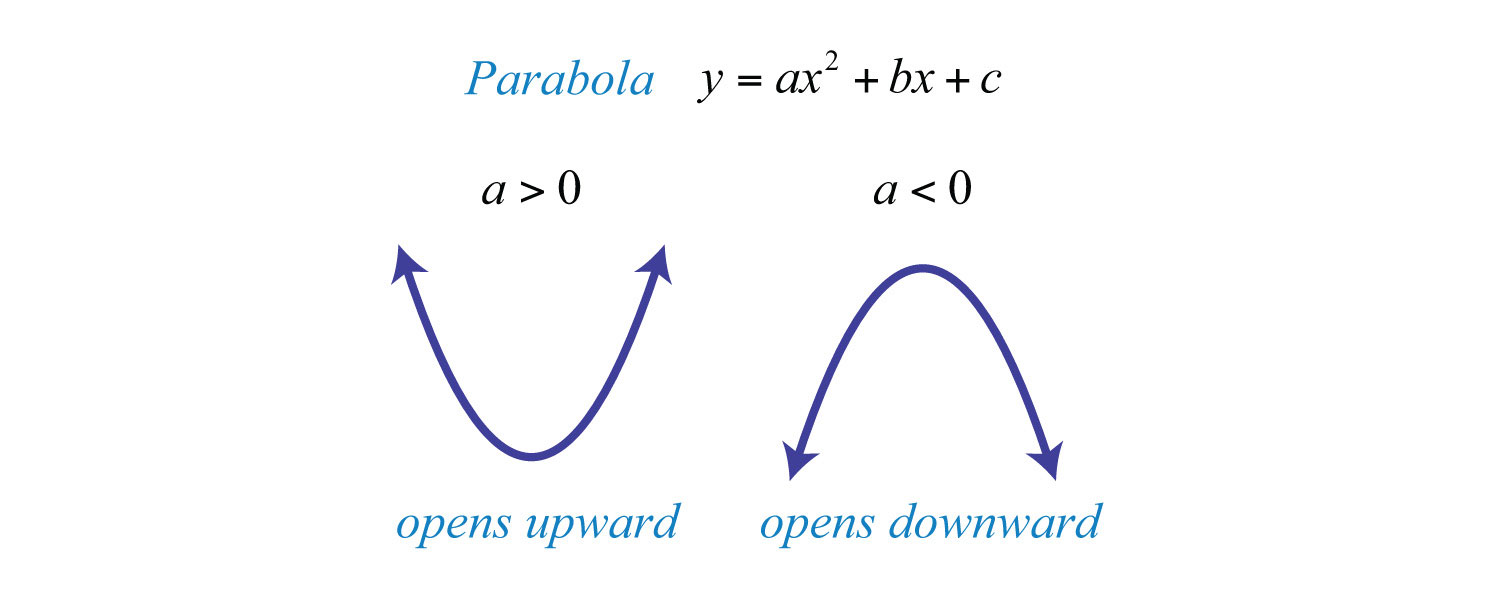
Parabola opens upward when a > 0
Characteristics:
- Vertex is the minimum point
- Domain: All real numbers
- Range: [k, ∞) where k is y-coordinate of vertex
Parabola Opening Downward (a < 0)
When the coefficient of x² is negative, the parabola opens downward (∩-shaped).
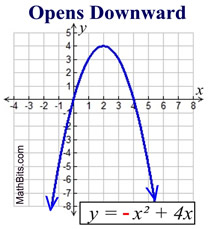
Parabola opens downward when a < 0
Characteristics:
- Vertex is the maximum point
- Domain: All real numbers
- Range: (-∞, k] where k is y-coordinate of vertex
Nature of Roots – Graphical Cases
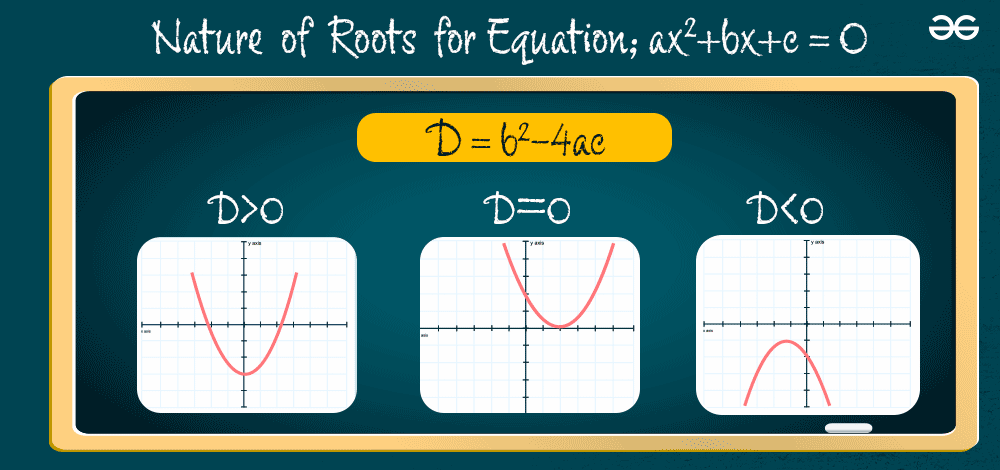
Nature of roots based on discriminant value
Case Analysis:
- D > 0: Graph cuts x-axis at two distinct points (two real roots)
- D = 0: Graph touches x-axis at exactly one point (equal roots)
- D < 0: Graph does not intersect x-axis (no real roots)
8️⃣ Most Important Board Questions
★ 1 Mark Questions
- Check whether (x - 3)² = x² - 6x + 9 is a quadratic equation.
- Find the discriminant of: 2x² - 3x + 5 = 0
- Write the standard form of quadratic equation.
- If D = 0, what is the nature of roots?
★★ 2-3 Mark Questions
- Solve by factorization: x² - 9x + 20 = 0
- Find the roots using quadratic formula: x² + 7x + 10 = 0
- Determine the nature of roots: 3x² - 2x + 1/3 = 0
- Find k if x = 3 is a root of kx² - 7x + 3 = 0
★★★ 4-5 Mark Questions
- Solve: (x + 4)/(x - 4) + (x - 4)/(x + 4) = 10/3, x ≠ ±4
- Find two consecutive odd positive integers whose sum of squares is 290.
- A train travels 360 km at a uniform speed. If the speed had been 5 km/h more, it would have taken 1 hour less. Find the speed of the train.
- The sum of the ages of a father and son is 45 years. Five years ago, the product of their ages was four times the father's age at that time. Find their present ages.
★ Frequently Repeated CBSE Questions
- Area-based problems (rectangles, paths)
- Speed-distance-time problems
- Number problems (consecutive integers)
- Age problems
- Work and time problems
9️⃣ Word Problems Section – CBSE Class 10 Maths Notes
Type 1: Area-Based Problem
Question: The length of a rectangular field is 5 metres more than its breadth. If the area of the field is 500 m², find its dimensions.
Let breadth = x metres
Then length = (x + 5) metres
Area = length × breadth
x(x + 5) = 500
x² + 5x - 500 = 0
Factorizing:
x² + 25x - 20x - 500 = 0
x(x + 25) - 20(x + 25) = 0
(x + 25)(x - 20) = 0
x = -25 or x = 20 (breadth cannot be negative)
Breadth = 20 m, Length = 25 m
Type 2: Number Problem
Question: The sum of a number and its reciprocal is 17/4. Find the number.
Let the number be x.
x + 1/x = 17/4
(x² + 1)/x = 17/4
4x² + 4 = 17x
4x² - 17x + 4 = 0
Using quadratic formula:
x = [17 ± √(289 - 64)] / 8
x = [17 ± √225] / 8
x = [17 ± 15] / 8
x₁ = 32/8 = 4
x₂ = 2/8 = 1/4
Type 3: Speed-Distance Problem
Question: A motor boat whose speed is 18 km/h in still water takes 1 hour more to go 24 km upstream than to return downstream. Find the speed of the stream.
Let speed of stream = x km/h
Speed upstream = (18 - x) km/h
Speed downstream = (18 + x) km/h
Time upstream = 24/(18 - x)
Time downstream = 24/(18 + x)
According to question:
24/(18 - x) - 24/(18 + x) = 1
24[(18 + x) - (18 - x)] / [(18 - x)(18 + x)] = 1
24(2x) / (324 - x²) = 1
48x = 324 - x²
x² + 48x - 324 = 0
x² + 54x - 6x - 324 = 0
x(x + 54) - 6(x + 54) = 0
(x + 54)(x - 6) = 0
x = -54 (rejected) or x = 6
Speed of stream = 6 km/h
Type 4: Geometry-Based Problem
Question: The hypotenuse of a right triangle is 25 cm. The difference between the lengths of the other two sides is 5 cm. Find the sides.
Let shorter side = x cm
Then longer side = (x + 5) cm
By Pythagoras theorem:
x² + (x + 5)² = 25²
x² + x² + 10x + 25 = 625
2x² + 10x - 600 = 0
x² + 5x - 300 = 0
x² + 20x - 15x - 300 = 0
x(x + 20) - 15(x + 20) = 0
(x + 20)(x - 15) = 0
x = 15 (positive value)
Sides are: 15 cm, 20 cm, and 25 cm
🔟 Common Mistakes to Avoid
| Mistake | Why It Happens | How to Avoid |
|---|---|---|
| Sign Errors | Confusion with negative signs in b | Write coefficients clearly: b = -5 means use -(-5) = +5 in formula |
| Wrong Discriminant | Forgetting D = b² - 4ac | Always write formula before substituting |
| Skipping Formula | Overconfidence in mental math | Write formula first - carries method marks |
| Arithmetic Mistakes | Rushing calculations | Double-check: √25 = 5, not ±5 in formula |
| Not Checking Nature | Solving when D < 0 | Calculate D first; if D < 0, write "no real roots" |
| Variable Confusion | Mixing up length/breadth | Define variables clearly with units |
Practice Section – Test Your Knowledge
Multiple Choice Questions
Q1. Which of the following is NOT a quadratic equation?
Q2. The discriminant of 2x² - 4x + 3 = 0 is:
Q3. If the roots of x² + kx + 12 = 0 are equal, then k =
Assertion-Reason Questions
Q4.
Assertion (A): The equation x² + x + 1 = 0 has no real roots.
Reason (R): For the equation ax² + bx + c = 0, if b² - 4ac < 0, then roots are not real.
a) Both A and R are true and R is the correct explanation of A
b) Both A and R are true but R is not the correct explanation of A
c) A is true but R is false
d) A is false but R is true
Case-Study Based Question
Q5. A rectangular park has a length that is twice its breadth. A path of uniform width 2 metres runs around the inside of the park. The area of the path is 196 m².
i) If breadth of park is x metres, express length in terms of x.
ii) Form a quadratic equation for finding the dimensions.
iii) Find the actual dimensions of the park.
HOTS Questions
Q6. If α and β are roots of x² - px + q = 0, find the value of α² + β².
Q7. Solve for x: 1/(x+1) + 2/(x+2) = 4/(x+4), where x ≠ -1, -2, -4
FAQ Section – CBSE Class 10 Maths Notes
Yes, Quadratic Equations is one of the most important chapters in CBSE Class 10 Notes. It carries 4-6 marks in the board exam and concepts are essential for Class 11 Mathematics. NCERT exercises and examples are directly asked in exams.
The Quadratic Formula method is the safest and most reliable for board exams because:
- It works for all types of quadratic equations
- Step-wise marking is easier to obtain
- Less chance of calculation errors compared to factorization
- Always mention the formula before substituting values
Absolutely! These NCERT Class 10 Maths Notes are 100% aligned with the latest CBSE syllabus and NCERT textbook (Chapter 4). All definitions, formulas, and solved examples follow NCERT pattern and marking scheme.
These Class 10 Maths Notes PDF format notes cover all topics from Chapter 4 including solved examples, important formulas, and board questions. Save this page or print for offline revision.
Quadratic Equations typically carries 4-6 marks in the CBSE Class 10 Board Exam, usually distributed as:
- 1 mark (MCQ/Fill in blank)
- 2-3 marks (Short answer - solving equations)
- 4-5 marks (Long answer - word problems)
Conclusion
Mastering Quadratic Equations is crucial for scoring well in CBSE Class 10 Mathematics. These CBSE Class 10 Notes provide comprehensive coverage of all concepts, formulas, and question types. Remember to:
- Practice all NCERT examples and exercises
- Memorize the quadratic formula and discriminant conditions
- Solve previous year board papers
- Focus on word problems for 4-5 mark questions
- Revise nature of roots thoroughly
Keep practicing and ace your CBSE Board Exams!
Next Chapter: Arithmetic Progressions – CBSE Class 10 Notes
Related Resources: NCERT Solutions Class 10 Maths | CBSE Sample Papers 2024-25 | Previous Year Question Papers | Important Formulas Sheet
These CBSE Class 10 Maths Notes are prepared by expert mathematics faculty with 15+ years of teaching experience. For any queries regarding Class 10 Maths Chapter 4 Notes, feel free to ask in the comments section.
