
CBSE Class 10 Maths Notes - chapter 15 Probability
Introduction
Welcome to these comprehensive CBSE Class 10 Notes for Mathematics chapter 15: Probability. Probability is the branch of mathematics that measures the likelihood of an event occurring. It quantifies uncertainty and helps us predict outcomes in situations involving chance.
Why this chapter matters:
- High Scoring: Probability carries approximately 4-6 marks in the CBSE Class 10 Board Exam
- Real-life Applications: Used in weather forecasting, insurance, medical research, games, and business decisions
- Foundation for Future: Essential for Class 11-12 Statistics and competitive exams
These CBSE Class 10 Maths Notes are 100% aligned with the latest NCERT syllabus and are perfect for board exam preparation, school exams, and competitive foundation courses.
Chapter Overview
These CBSE Class 10 Notes cover the following key topics:
- Random Experiment - Experiments with unpredictable outcomes
- Sample Space - Set of all possible outcomes
- Event - Subset of sample space
- Probability Formula - Theoretical probability calculation
- Complementary Events - Events that complete the sample space
- Word Problems - Real-life application questions
Key Concepts (NCERT Accurate)
Random Experiment
An experiment is called a random experiment if:
- It has more than one possible outcome
- The exact outcome cannot be predicted in advance
- All possible outcomes are known
Examples: Tossing a coin, throwing a die, drawing a card from a deck
Sample Space (S)
The set of all possible outcomes of a random experiment is called the sample space.
| Experiment | Sample Space (S) | Number of Outcomes n(S) |
|---|---|---|
| Tossing one coin | {H, T} | 2 |
| Tossing two coins | {HH, HT, TH, TT} | 4 |
| Throwing one die | {1, 2, 3, 4, 5, 6} | 6 |
| Throwing two dice | {(1,1), (1,2), ..., (6,6)} | 36 |
| Drawing a card from deck | 52 different cards | 52 |
Event (E)
An event is a subset of the sample space. It represents the favorable outcomes for which we want to find the probability.
Types of Events:
- Simple Event: Single outcome (e.g., getting Head)
- Compound Event: Multiple outcomes (e.g., getting an even number on die)
- Sure Event: Probability = 1 (e.g., getting a number less than 7 on die)
- Impossible Event: Probability = 0 (e.g., getting 7 on standard die)
Theoretical Probability Formula
Or P(E) = n(E) / n(S)
- P(E) = Probability of event E
- n(E) = Number of outcomes favorable to E
- n(S) = Total number of possible outcomes in sample space
Probability Range
For any event E: 0 ≤ P(E) ≤ 1
- P(E) = 0: Impossible event
- P(E) = 1: Sure or certain event
- 0 < P(E) < 1: Uncertain event
Complementary Events
If E is an event, then E' (or Ē) represents "not E" (complement of E).
Or P(E') = 1 - P(E)
When to use complement method: When calculating P(E) directly is difficult, but P(E') is easier to find.
Important Formulas (Quick Reference)
| Formula | Expression | When to Use |
|---|---|---|
| Probability | P(E) = n(E)/n(S) | Basic probability calculation |
| Complement | P(E') = 1 - P(E) | When direct calculation is complex |
| Total Probability | P(E) + P(E') = 1 | Verification and complement problems |
| Range | 0 ≤ P(E) ≤ 1 | Checking validity of probability |
- Use when question asks for "at least one" or "not" type probability
- Calculate probability of unfavorable outcomes first
- Subtract from 1 to get favorable probability
Solved Examples (CBSE Pattern)
Example 1: Coin Toss (Easy)
Question: A coin is tossed once. What is the probability of getting a head?
Solution:
Step 1: Write sample space
- S = {H, T}
- n(S) = 2
Step 2: Define event
- E = Getting a head = {H}
- n(E) = 1
Step 3: Apply formula
P(E) = n(E)/n(S) = 1/2
Answer: 1/2 or 0.5
Example 2: Two Coins (Moderate)
Question: Two coins are tossed simultaneously. Find the probability of getting:
- (i) Two heads
- (ii) At least one head
- (iii) At most one head
Solution:
Step 1: Sample space
- S = {HH, HT, TH, TT}
- n(S) = 4
(i) Probability of two heads:
- E = {HH}
- n(E) = 1
- P(E) = 1/4
(ii) Probability of at least one head:
- E = {HH, HT, TH}
- n(E) = 3
- P(E) = 3/4
(iii) Probability of at most one head:
- E = {HT, TH, TT}
- n(E) = 3
- P(E) = 3/4
Example 3: Dice Problem
Question: A die is thrown once. Find the probability of getting:
- (i) A prime number
- (ii) A number greater than 4
- (iii) A number less than or equal to 4
Solution:
Step 1: Sample space
- S = {1, 2, 3, 4, 5, 6}
- n(S) = 6
(i) Prime number:
- E = {2, 3, 5}
- n(E) = 3
- P(E) = 3/6 = 1/2
(ii) Number greater than 4:
- E = {5, 6}
- n(E) = 2
- P(E) = 2/6 = 1/3
(iii) Number less than or equal to 4:
- E = {1, 2, 3, 4}
- n(E) = 4
- P(E) = 4/6 = 2/3
Example 4: Card Selection
Question: One card is drawn from a well-shuffled deck of 52 cards. Find the probability of getting:
- (i) A king
- (ii) A red card
- (iii) A face card
- (iv) Not a heart
Solution:
n(S) = 52
(i) Probability of getting a king:
- Number of kings = 4
- P(King) = 4/52 = 1/13
(ii) Probability of getting a red card:
- Number of red cards = 26 (13 hearts + 13 diamonds)
- P(Red) = 26/52 = 1/2
(iii) Probability of getting a face card:
- Face cards = Jack, Queen, King of each suit = 12
- P(Face card) = 12/52 = 3/13
(iv) Probability of not getting a heart:
Method 1: Number of non-heart cards = 52 - 13 = 39
P(Not heart) = 39/52 = 3/4
Method 2 (Complement):
- P(Heart) = 13/52 = 1/4
- P(Not heart) = 1 - 1/4 = 3/4
Example 5: Complement-Based Problem (Board Level)
Question: A bag contains 5 red balls and some blue balls. If the probability of drawing a blue ball is double that of a red ball, find the number of blue balls.
Solution:
Let number of blue balls = x
Total balls = 5 + x
P(Red) = 5/(5 + x)
P(Blue) = x/(5 + x)
According to question:
P(Blue) = 2 × P(Red)
x/(5 + x) = 2 × [5/(5 + x)]
x/(5 + x) = 10/(5 + x)
x = 10
Answer: Number of blue balls = 10
Example 6: Two Dice (Advanced)
Question: Two different dice are thrown together. Find the probability that the sum of numbers appearing is:
- (i) 7
- (ii) Less than 12
- (iii) At least 10
Solution:
Step 1: Sample space for two dice
- n(S) = 6 × 6 = 36
(i) Sum = 7:
- Favorable outcomes: (1,6), (2,5), (3,4), (4,3), (5,2), (6,1)
- n(E) = 6
- P(Sum = 7) = 6/36 = 1/6
(ii) Sum less than 12:
- Unfavorable outcome: Only (6,6) gives sum = 12
- P(Sum = 12) = 1/36
- P(Sum < 12) = 1 - 1/36 = 35/36
(iii) Sum at least 10 (≥ 10):
- Favorable: Sum = 10, 11, or 12
- (4,6), (5,5), (6,4), (5,6), (6,5), (6,6)
- n(E) = 6
- P(Sum ≥ 10) = 6/36 = 1/6
Smart Tricks for Board Exams
Complement Shortcut Trick
When you see "at least one" or "not" in the question:
- Calculate P(not happening) or P(none)
- Use P(E) = 1 - P(E')
- This saves time and reduces calculation errors
Example: Probability of getting at least one head in 3 coin tosses
- P(No head) = P(TTT) = 1/8
- P(At least one head) = 1 - 1/8 = 7/8
Quick Sample Space Listing Trick
| Experiment | Quick Counting |
|---|---|
| n coins | n(S) = 2n |
| n dice | n(S) = 6n |
| 1 coin + 1 die | n(S) = 2 × 6 = 12 |
| 2 cards from 52 | n(S) = 52 × 51 (without replacement) |
Dice/Card Probability Shortcut
For Dice:
- Sum of 7 has maximum probability (6/36 = 1/6)
- Sums 2 and 12 have minimum probability (1/36 each)
For Cards (52 cards):
- P(Spade) = P(Heart) = P(Diamond) = P(Club) = 1/4
- P(Red) = P(Black) = 1/2
- P(Face card) = 12/52 = 3/13
- P(Number card) = 40/52 = 10/13
Fraction Simplification Trick
- Always simplify fractions to lowest terms
- Convert to decimal only if specified
- Keep answer as proper fraction for exactness
Time-Saving Board Strategy
- Write sample space clearly (carries 1 mark)
- Count n(S) and n(E) carefully
- Write formula: P(E) = n(E)/n(S)
- Substitute values
- Simplify and box the answer
- Verify: Check if 0 ≤ P(E) ≤ 1
Visual Learning
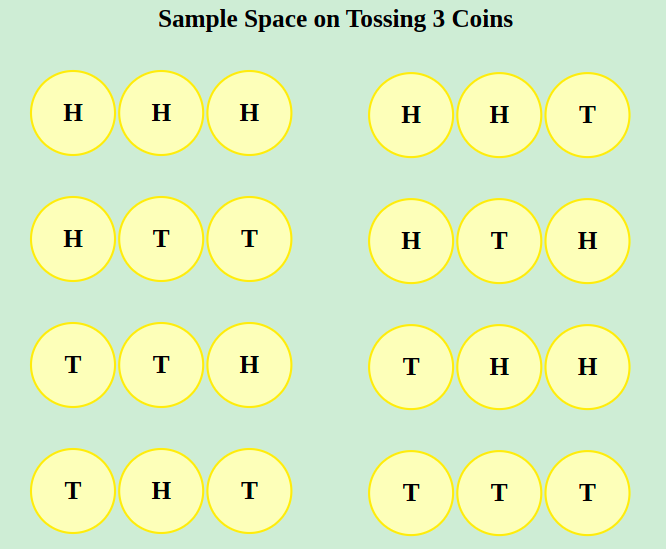
Figure 1: Sample Space for Tossing Three Coins
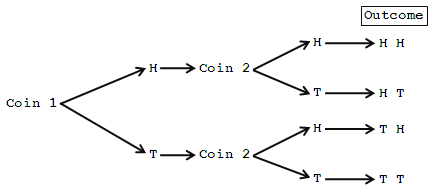
Figure 2: Tree Diagram for Two Coin Tosses
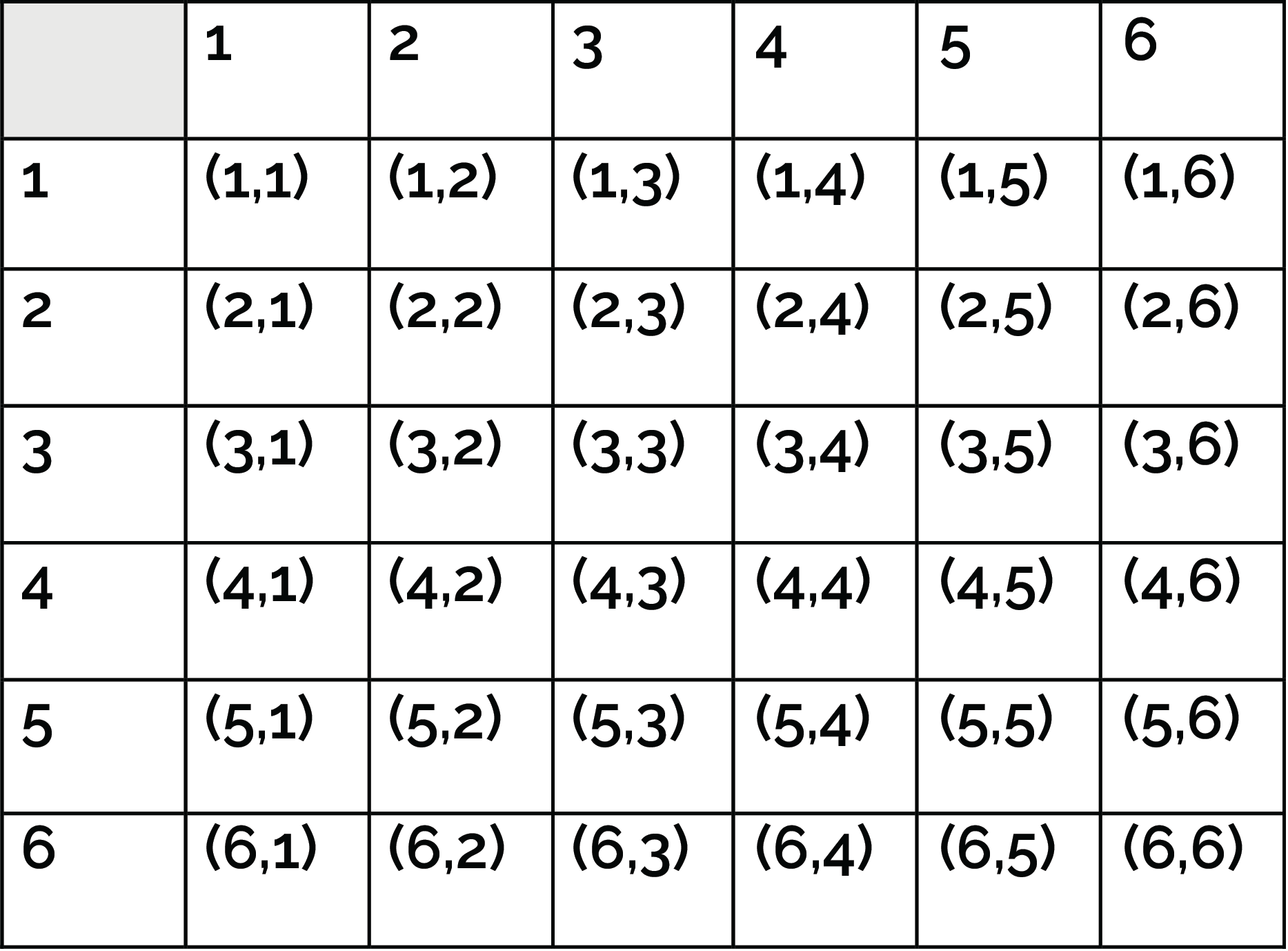
Figure 3: Sample Space Table for Two Dice
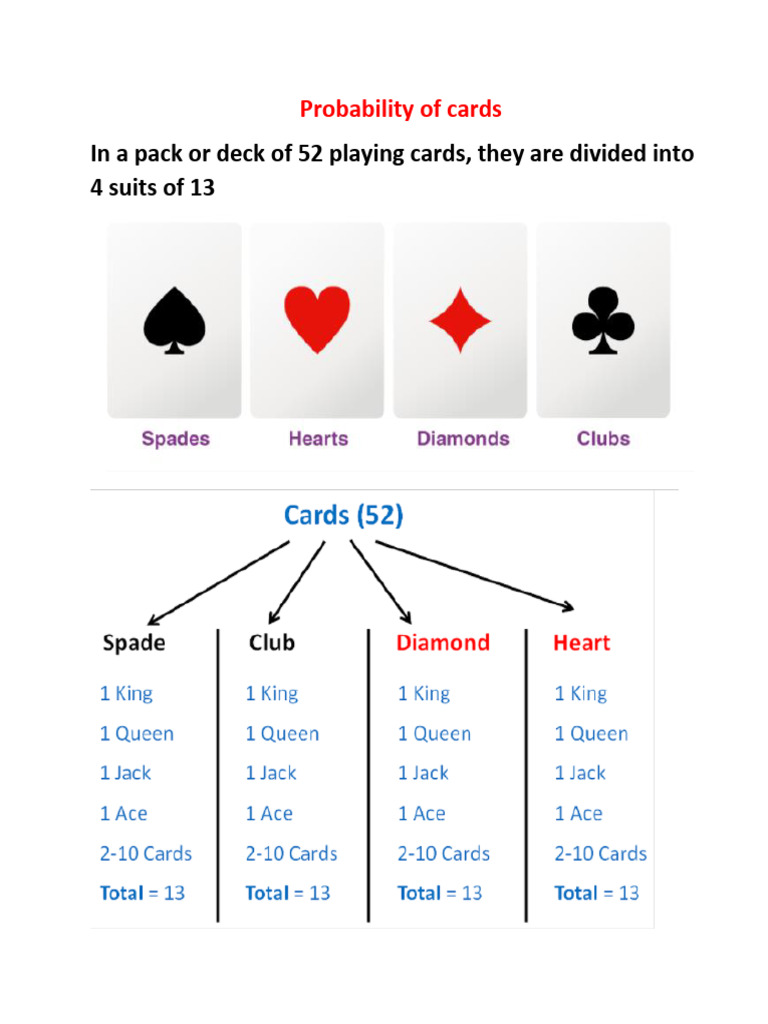
Figure 4: Playing Cards Probability Diagram
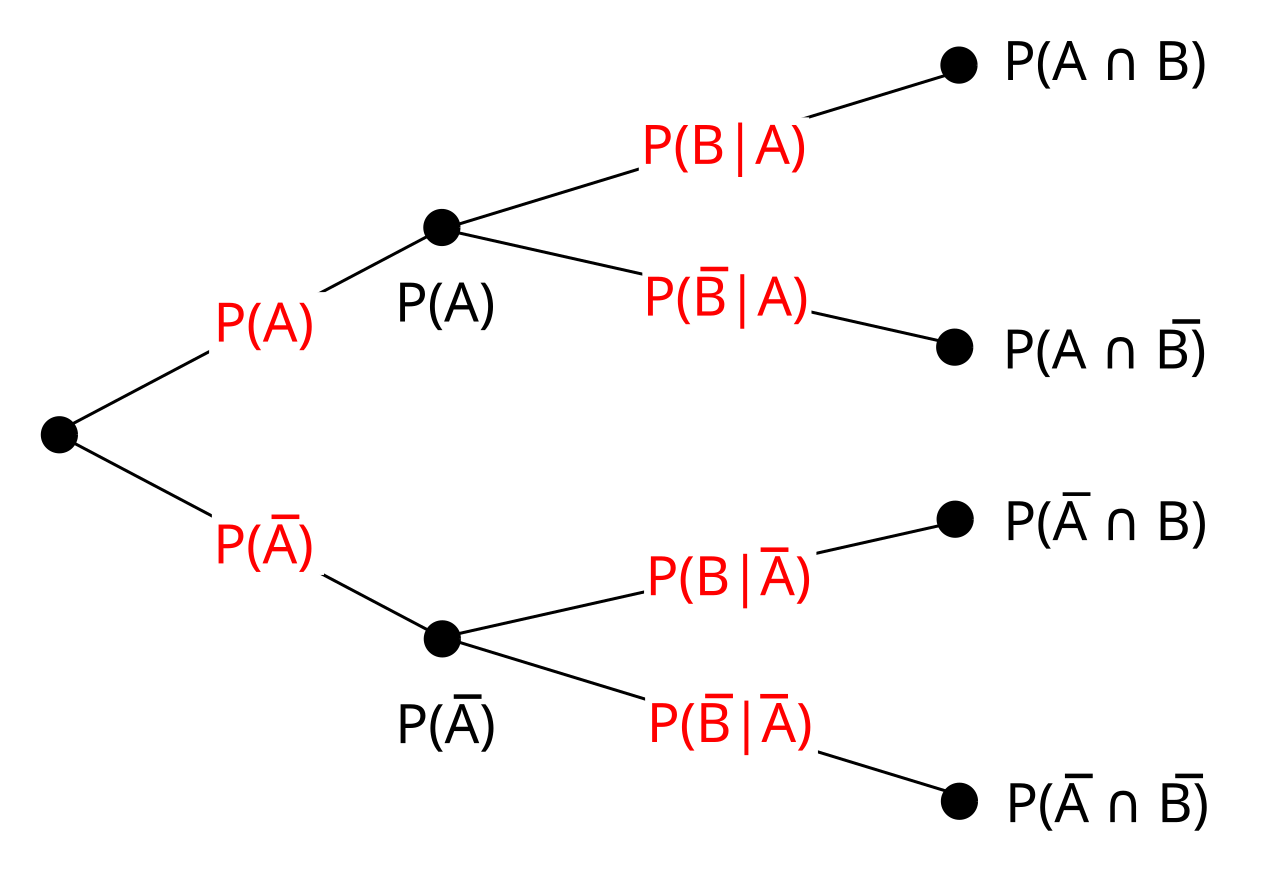
Figure 5: Probability Tree Diagram
Most Important Board Questions
1 Mark Questions
- What is the probability of a certain event? (1M)
- Define sample space. (1M)
- If P(E) = 0.3, what is P(E')? (1M)
- A die is thrown once. What is the probability of getting a number less than 3? (1M)
2-3 Mark Questions
- Two coins are tossed simultaneously. Find the probability of getting at most one head. (2M)
- * One card is drawn from a deck of 52 cards. Find the probability of getting:
- (i) A black king
- (ii) Neither a heart nor a king
- * A bag contains 3 red balls and 5 black balls. A ball is drawn at random. Find the probability that the ball drawn is:
- (i) Red
- (ii) Not black
4 Mark Word Problems
- ** Two dice are thrown simultaneously. Find the probability that the sum of numbers on the two dice is:
- (i) 8
- (ii) 13
- (iii) Less than or equal to 12
- ** A game consists of tossing a one-rupee coin 3 times and noting its outcome each time. Hanif wins if all the tosses give the same result (three heads or three tails) and loses otherwise. Calculate the probability that Hanif will lose the game. (4M)
Case-Study Based Question
- ** Case Study: A survey was conducted to find the blood groups of 30 students:
Blood Group A B AB O Number of Students 9 6 3 12 - (i) What is the probability that a randomly chosen student has blood group O? (1M)
- (ii) What is the probability that a randomly chosen student has blood group AB? (1M)
- (iii) Find the probability that a student does not have blood group B. (2M)
- Coin toss problems (1, 2, or 3 coins)
- Die throw problems (single or double dice)
- Card selection from deck
- Ball drawing from bags
- Complement-based probability questions
- Word problems involving real-life scenarios
Common Mistakes to Avoid
| Mistake | Correction |
|---|---|
| Writing incorrect sample space | List all outcomes systematically |
| Counting repeated outcomes twice | Use table format for two dice/coins |
| Ignoring complement method | Use when "at least" or "not" appears |
| Not simplifying fractions | Always reduce to lowest terms |
| Probability > 1 or < 0 | Verify: 0 ≤ P(E) ≤ 1 |
| Confusing "and" with "or" | "And" = multiply, "Or" = add (mutually exclusive) |
| Forgetting to write formula | Formula carries 1/2 mark |
| Calculation errors | Double-check n(E) and n(S) |
Practice Section
MCQs
Q1. Which of the following cannot be the probability of an event?
- (a) 0
- (b) 0.5
- (c) 1
- (d) 1.5
Q2. If P(E) = 0.65, then P(E') is:
- (a) 0.35
- (b) 0.65
- (c) 1.65
- (d) 0
Q3. The probability of getting an even number when a die is thrown is:
- (a) 1/2
- (b) 1/3
- (c) 1/6
- (d) 2/3
Assertion-Reason
Q4.
Assertion (A): The probability of getting a number 8 when a die is thrown is 0.
Reason (R): The probability of an impossible event is 0.
Choose the correct option:
- (a) Both A and R are true and R is the correct explanation of A
- (b) Both A and R are true but R is not the correct explanation of A
- (c) A is true but R is false
- (d) A is false but R is true
Case-Study Based
Q5. Case Study: A box contains 90 discs numbered from 1 to 90. If one disc is drawn at random:
- (i) Find the probability that it bears a two-digit number. (1M)
- (ii) Find the probability that it bears a perfect square number. (1M)
- (iii) Find the probability that it bears a number divisible by 5. (2M)
HOTS Questions
Q6. A card is drawn at random from a well-shuffled deck of playing cards. Find the probability that the card drawn is:
- (i) A card of spades or an ace
- (ii) A red king
- (iii) Neither a king nor a queen
Q7. Two customers Shyam and Ekta are visiting a shop from Tuesday to Saturday. Each is equally likely to visit on any day. What is the probability that both will visit the shop on:
- (i) The same day?
- (ii) Consecutive days?
- (iii) Different days?
Frequently Asked Questions (FAQ)
Is Probability important for CBSE Class 10 board exam?
Yes, absolutely! Probability carries 4-6 marks in the CBSE Class 10 Board Exam. It is one of the most scoring chapters in CBSE Class 10 Maths Notes because questions are straightforward and formula-based. With proper practice, you can easily score full marks in this chapter.
What is theoretical probability?
Theoretical probability (also called classical probability) is calculated using the formula P(E) = n(E)/n(S) without actually performing the experiment. It is based on the assumption that all outcomes are equally likely. These CBSE Class 10 Notes focus on theoretical probability as per the NCERT syllabus.
Are these CBSE Class 10 Maths Notes based on NCERT?
Yes, 100%! These CBSE Class 10 Notes are completely aligned with the latest NCERT textbook for Class 10 Mathematics. All formulas, examples, and concepts strictly follow the NCERT pattern and are verified by experienced mathematics teachers with 15+ years of experience.
When should I use the complement method?
Use the complement method when the question asks for "at least one," "not," or when direct calculation involves too many cases. The formula P(E) = 1 - P(E') simplifies complex problems significantly. This trick is emphasized in these CBSE Class 10 Maths Notes for board exam efficiency.
What is the difference between experimental and theoretical probability?
Theoretical probability is calculated mathematically using formulas (P = n(E)/n(S)). Experimental probability is based on actual experiments and observations (P = Number of trials where event occurred / Total number of trials). CBSE Class 10 Notes focus primarily on theoretical probability.
Conclusion
Mastering Probability requires clear understanding of sample space and systematic counting of favorable outcomes. These CBSE Class 10 Maths Notes provide you with comprehensive coverage of all concepts - from basic coin toss problems to advanced complement-based questions.
- Memorize the basic formula: P(E) = n(E)/n(S)
- Practice listing sample spaces for coins, dice, and cards
- Master the complement method for "at least" type questions
- Solve previous year board questions (last 5 years)
- Verify that your answer is always between 0 and 1
Complete Your Preparation: Access Complete CBSE Class 10 Notes - All Chapters for comprehensive coverage of the entire syllabus.
Keywords: CBSE Class 10 Notes, CBSE Class 10 Maths Notes, Class 10 Maths chapter 15 Notes, Probability Class 10 Notes, Theoretical Probability Class 10, NCERT Class 10 Maths Notes, Class 10 Maths Notes PDF
