
CBSE Class 10 Maths Notes - Chapter 13 Surface Areas and Volumes
CBSE Class 10 Notes for Mathematics Chapter 13 "Surface Areas and Volumes" provide comprehensive coverage of three-dimensional geometry concepts essential for your board examination. This chapter extends your understanding of solid shapes by calculating their external coverage (surface area) and internal capacity (volume).
Real-life applications include calculating paint required for walls, water tank capacity, ice cream cone volumes, and spherical tank designs. In CBSE Class 10 Maths Notes, this chapter carries approximately 7-10 marks in the board examination, making it crucial for scoring well.
These CBSE Class 10 Notes are 100% aligned with NCERT textbook guidelines and cover all topics from basic solids to combination shapes and frustums. Whether you are preparing for school exams, pre-boards, or the final CBSE Board examination, these notes provide the conceptual clarity and practice needed for success.
Chapter Overview
CBSE Class 10 Maths Notes Chapter 13 covers the following key topics:
- Cube and Cuboid - Basic rectangular solids
- Cylinder - Right circular cylinders and hollow cylinders
- Cone - Right circular cones and their properties
- Sphere and Hemisphere - Perfectly round solids
- Frustum of Cone - Truncated cone (cone with top cut off)
- Combination Solids - Two or more solids joined together
- Word Problems - Real-life application questions
Key Concepts (NCERT Aligned)
Cube
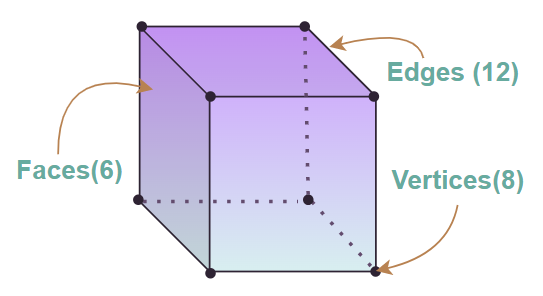
A cube has 6 equal square faces, 12 edges, and 8 vertices.
Cube Formulas
Total Surface Area (TSA) = 6a2 (where 'a' = side length)
Volume = a3
Reasoning: Since all 6 faces are identical squares of area a2, total surface area is 6 times one face.
Cuboid
A cuboid has 6 rectangular faces with length (l), breadth (b), and height (h).
Cuboid Formulas
TSA = 2(lb + bh + hl)
Volume = lbh
Reasoning: Opposite faces are equal. We calculate area of all three unique pairs and multiply by 2.
Cylinder
A right circular cylinder has two circular bases and a curved surface.
Cylinder Formulas
Curved Surface Area (CSA) = 2πrh
TSA = 2πr(h + r) or 2πrh + 2πr2
Volume = πr2h
Reasoning: When unrolled, the curved surface forms a rectangle with height 'h' and width equal to circumference (2πr).
Cone
A right circular cone has a circular base and a curved surface tapering to a vertex.
Cone Formulas
CSA = πrl (where l = slant height = √(h2 + r2))
TSA = πr(l + r) or πrl + πr2
Volume = (1/3)πr2h
Reasoning: The (1/3) factor indicates a cone has one-third the volume of a cylinder with same base and height.
Sphere
A sphere is a perfectly round three-dimensional object.
Sphere Formulas
Surface Area = 4πr2
Volume = (4/3)πr3
Hemisphere
A hemisphere is half of a sphere.
Hemisphere Formulas
CSA = 2πr2 (curved surface only)
TSA = 3πr2 (curved + circular base)
Volume = (2/3)πr3
Frustum of Cone
When a cone is cut by a plane parallel to its base, the lower portion is called a frustum.
Frustum Formulas
CSA = π(r1 + r2)l (where r1 = top radius, r2 = base radius, l = slant height)
Volume = (1/3)πh(r12 + r22 + r1r2)
Note: Slant height l = √[h2 + (r2 - r1)2]
Important Formulas Summary
| Solid | CSA | TSA | Volume |
|---|---|---|---|
| Cube | 4a2 | 6a2 | a3 |
| Cuboid | 2h(l + b) | 2(lb + bh + hl) | lbh |
| Cylinder | 2πrh | 2πr(h + r) | πr2h |
| Cone | πrl | πr(l + r) | (1/3)πr2h |
| Sphere | - | 4πr2 | (4/3)πr3 |
| Hemisphere | 2πr2 | 3πr2 | (2/3)πr3 |
| Frustum | π(r1+r2)l | π(r1+r2)l + πr12 + πr22 | (1/3)πh(r12+r22+r1r2) |
When to Use Each Formula:
Use CSA when: Finding material for lamp shades (cylinder), canvas for tents (cone), painting only curved parts of hemispherical domes.
Use TSA when: Painting entire closed boxes, wrapping gifts completely, finding metal sheet required for closed tanks.
Use Volume when: Calculating water tank capacity, determining ice cream quantity, finding storage capacity of containers.
Solved Examples (CBSE Pattern)
Example 1: Easy (Cube)
Question: Find the total surface area and volume of a cube with side 5 cm.
Solution:
Given: Side (a) = 5 cm
Step 1: Write formulas
TSA = 6a2
Volume = a3
Step 2: Calculate TSA
TSA = 6 × (5)2 = 6 × 25 = 150 cm2
Step 3: Calculate Volume
Volume = (5)3 = 125 cm3
Example 2: Moderate (Cylinder)
Question: A cylindrical pipe has length 28 m and diameter 5 cm. Find the cost of painting its curved surface at Rs. 5 per cm2.
Solution:
Given:
- Length (h) = 28 m = 2800 cm
- Diameter = 5 cm, so radius (r) = 2.5 cm
Step 1: Formula for CSA of cylinder
CSA = 2πrh
Step 2: Calculate CSA
CSA = 2 × (22/7) × 2.5 × 2800
CSA = 2 × 22 × 2.5 × 400
CSA = 44,000 cm2
Step 3: Calculate cost
Cost = 44,000 × 5 = Rs. 2,20,000
Example 3: Frustum
Question: A frustum of a cone has radii 20 cm and 8 cm, and height 16 cm. Find its volume.
Solution:
Given: r1 = 20 cm, r2 = 8 cm, h = 16 cm
Step 1: Volume formula for frustum
V = (1/3)πh(r12 + r22 + r1r2)
Step 2: Substitute values
V = (1/3) × (22/7) × 16 × [(20)2 + (8)2 + (20×8)]
V = (1/3) × (22/7) × 16 × [400 + 64 + 160]
V = (1/3) × (22/7) × 16 × 624
Step 3: Calculate
V = (22 × 16 × 624) / 21
V = 219,648 / 21
V = 10,459.43 cm3 (approx)
Example 4: Combination Solid
Question: A toy consists of a cone mounted on a hemisphere. The diameter of both is 6 cm, and total height is 10 cm. Find the total surface area.
Solution:
Given:
- Diameter = 6 cm, so radius (r) = 3 cm
- Total height = 10 cm
- Height of cone (h) = 10 - 3 = 7 cm
Step 1: Find slant height of cone
l = √(h2 + r2) = √(49 + 9) = √58 ≈ 7.62 cm
Step 2: CSA of cone
CSAcone = πrl = (22/7) × 3 × 7.62 ≈ 71.88 cm2
Step 3: CSA of hemisphere
CSAhemi = 2πr2 = 2 × (22/7) × 9 = 56.57 cm2
Step 4: Total Surface Area
TSA = CSAcone + CSAhemi = 71.88 + 56.57 = 128.45 cm2
Example 5: Board-Level Word Problem
Question: A cylindrical vessel of diameter 14 cm and height 42 cm is filled with water. This water is poured into small conical cups of diameter 7 cm and height 6 cm. How many cups can be filled?
Solution:
Given:
- Cylinder: r = 7 cm, h = 42 cm
- Cone: r = 3.5 cm, h = 6 cm
Step 1: Volume of cylinder
Vcyl = πr2h = (22/7) × 7 × 7 × 42 = 6,468 cm3
Step 2: Volume of one cone
Vcone = (1/3)πr2h = (1/3) × (22/7) × 3.5 × 3.5 × 6
Vcone = (1/3) × (22/7) × 12.25 × 6 = 77 cm3
Step 3: Number of cups
Number = 6,468 / 77 = 84 cups
Smart Tricks for CBSE Board Exam
Unit Conversion Trick
cm3 ↔ m3: Remember 1 m3 = 1,000,000 cm3 (106)
- To convert cm3 → m3: Divide by 1,000,000
- To convert m3 → cm3: Multiply by 1,000,000
Quick check: If answer seems too large or small, check units.
π Value Strategy
- Use 22/7 when radius or diameter is divisible by 7
- Use 3.14 when radius is a decimal
- If question says "take π = 22/7", you MUST use it
Combination Solid Splitting
Always break combination solids into individual components:
- Identify each solid shape
- Calculate required parameter for each
- Add or subtract as per question requirement
- Never double-count joining surfaces
Frustum Memory Trick
Remember frustum is "cone minus cone":
- Volume formula has three terms (r12, r22, r1r2) - similar to (a3 - b3) pattern
- CSA uses sum of radii (r1 + r2) multiplied by slant height
Time-Saving Strategy
- Write formula first (carries marks even if calculation is wrong)
- Keep π symbolic until final step
- Check if answer choices match common π values
- For TSA of combination: Check if internal surfaces are exposed or joined
Visual Learning (Diagrams)
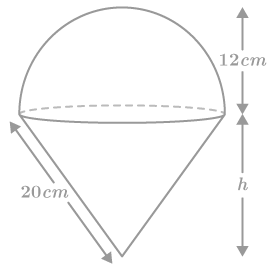
Understanding 3D shapes is crucial for CBSE Class 10 Maths Notes. Refer to these diagrams:


Most Important Board Questions
★ 1 Mark Questions
- Write the formula for volume of a sphere.
- Define frustum of a cone.
- What is the TSA of a hemisphere of radius r?
- How many liters equal 1 cubic meter?
★★ 2-3 Mark Questions
- Find the CSA of a cone with radius 7 cm and slant height 10 cm.
- A cube has volume 512 cm3. Find its surface area.
- Calculate the volume of a hemisphere with radius 21 cm.
- The height of a cylinder is 10 cm and radius 7 cm. Find its TSA.
★★★ 4-5 Mark Word Problems
- ★★★★★ A metallic sphere of radius 4.2 cm is melted and recast into a cylinder of radius 6 cm. Find the height of the cylinder.
- ★★★★ A cone of height 24 cm and radius 7 cm is made of modeling clay. A child reshapes it into a sphere. Find the radius of the sphere.
- ★★★★ A vessel is in the form of a hollow hemisphere mounted by a hollow cylinder. The diameter of the hemisphere is 14 cm and total height is 13 cm. Find the inner surface area.
- ★★★★★ A drinking glass is in the shape of a frustum of a cone with height 14 cm. The diameters of its two circular ends are 4 cm and 2 cm. Find the capacity of the glass.
★★★★ Case-Study Based Question
Water Conservation Campaign:
A school is installing rainwater harvesting tanks. They have two options:
- Option A: Cylindrical tank of radius 1.5 m and height 3.5 m
- Option B: Cuboidal tank of dimensions 2 m × 1.5 m × 2 m
Questions:
- Which tank has greater capacity? By how much?
- If cylindrical tank costs Rs. 500 per m2 and cuboidal costs Rs. 400 per m2, which is more economical to construct?
- What value is depicted by rainwater harvesting?
Common Mistakes to Avoid
Using CSA instead of TSA
Mistake: Calculating only curved surface when total surface is asked.
Fix: Read carefully. Words like "closed vessel," "total," "complete" indicate TSA.
Forgetting Unit Conversion
Mistake: Mixing meters and centimeters in calculations.
Fix: Convert all dimensions to the same unit before calculating.
Wrong π Value
Mistake: Using 3.14 when question specifies 22/7, or vice versa.
Fix: Check question instructions. Default to 22/7 for CBSE unless specified.
Calculation Errors
Mistake: Arithmetic errors in (1/3) or (4/3) calculations.
Fix: Always write fractions clearly. Cross-check with calculator if permitted.
Double Counting in Combinations
Mistake: Including the joining surface in TSA of combination solids.
Fix: Remember: joined surfaces are INTERNAL and not part of external TSA.
Wrong Slant Height Formula
Mistake: Using l = √(r2 - h2) instead of l = √(h2 + r2).
Fix: Remember Pythagoras: l2 = h2 + r2 (hypotenuse is slant height).
Practice Section
Multiple Choice Questions
Q1. The volume of a cube is 729 cm3. Its surface area is:
Q2. A cylinder and cone have same radius and height. The ratio of their volumes is:
Q3. The TSA of a hemisphere of radius 7 cm is:
Assertion-Reason Questions
Q4.
Assertion (A): The volume of a sphere of radius 2r is 8 times the volume of a sphere of radius r.
Reason (R): Volume of sphere varies directly with the cube of its radius.
HOTS Questions
Q5. A solid iron pole consists of a cylinder of height 220 cm and base diameter 24 cm, surmounted by another cylinder of height 60 cm and radius 8 cm. Find the mass of the pole, given that 1 cm3 of iron has approximately 8g mass. (Use π = 3.14)
Q6. A bucket is in the form of a frustum of a cone with radii 28 cm and 7 cm, and height 45 cm. Find the capacity of the bucket and the cost of milk that can completely fill the bucket at Rs. 40 per liter.
Frequently Asked Questions (FAQ)
Q: Is Surface Areas and Volumes important for CBSE Class 10 board?
A: Yes, absolutely. This chapter carries 7-10 marks in the CBSE Class 10 board examination. It includes both calculation-based and application-based questions. Regular practice of CBSE Class 10 Notes for this chapter ensures full marks in this section.
Q: When should I use CSA and when TSA?
A: Use CSA (Curved Surface Area) when only the curved or lateral part is involved (like painting walls of a cylindrical tank). Use TSA (Total Surface Area) when the entire closed surface needs calculation (like wrapping a complete box). For open vessels, use CSA + base area.
Q: Are these CBSE Class 10 Maths Notes based on NCERT?
A: Yes, these CBSE Class 10 Maths Notes are 100% aligned with the latest NCERT syllabus for Class 10 Mathematics. All formulas, examples, and question patterns follow NCERT guidelines and previous year CBSE board examination trends.
Q: How can I remember all the formulas?
A: Create a formula chart and place it where you study daily. Practice 5 questions daily using these CBSE Class 10 Notes. Understanding the derivation (like how cone volume is 1/3 of cylinder) helps in memorization. Use the visual diagrams provided above for better retention.
Q: What is the best strategy to solve combination solid problems?
A: Break the solid into individual components. Calculate the required parameter (CSA/TSA/Volume) for each separately. Then add or subtract based on the question. Never forget to exclude the joining surfaces when calculating TSA of combinations.
Conclusion
Mastering CBSE Class 10 Maths Notes for Chapter 13 Surface Areas and Volumes requires consistent practice and conceptual clarity. Focus on understanding when to apply each formula rather than rote memorization. Practice the solved examples provided above, avoid the common mistakes listed, and solve previous year board questions for best results.
Key Takeaways:
- Always write formulas before substituting values
- Maintain unit consistency throughout calculations
- Draw diagrams for combination solids
- Practice time management for 4-5 mark questions
Next Chapter: Continue your preparation with Statistics - CBSE Class 10 Notes for comprehensive board exam readiness.
Tags: CBSE Class 10 Notes, CBSE Class 10 Maths Notes, Class 10 Maths Chapter 13 Notes, Surface Areas and Volumes Class 10, Volume and TSA Formula Class 10, NCERT Class 10 Maths Notes, Class 10 Maths Notes PDF
Best of luck for your CBSE Board Examination!
