
CBSE Class 10 Maths Notes – Chapter 6 Triangles

1. Introduction
Welcome to the definitive CBSE Class 10 Notes for Chapter 6: Triangles. These CBSE Class 10 Maths Notes are expertly crafted by senior mathematics faculty to help you master one of the highest-scoring chapters in your board examination.
A triangle is a closed figure formed by three intersecting lines, having three sides, three angles, and three vertices. The study of similarity of triangles forms the cornerstone of geometric reasoning.
- High Weightage: Carries 6-8 marks in board exams
- Theorem-Heavy: Proofs are compulsory and scoring
- Foundation for Advanced Math: Essential for Class 11-12
- Real-World Applications: Used in surveying, architecture, engineering
These CBSE Class 10 Maths Notes follow the exact NCERT sequence and include every theorem, proof, and solved example prescribed by the CBSE syllabus.
2. Chapter Overview
| Aspect | Details |
|---|---|
| Topics Covered | Similar Figures, Similar Triangles, Criteria for Similarity, BPT, Pythagoras Theorem, Areas of Similar Triangles |
| Marks Weightage | 6-8 marks (Board Exam) |
| Difficulty Level | Moderate to High (Proof-based) |
| Question Types | MCQs, Short Answer (2-3 marks), Long Answer Proofs (4-5 marks) |
| NCERT Exercises | 6.1, 6.2, 6.3, 6.4, 6.5, 6.6 |
3. Key Concepts (100% NCERT Accurate)
Similar Figures
Two figures having the same shape (not necessarily the same size) are called similar figures. For triangles:
- Corresponding angles are equal
- Corresponding sides are in the same ratio (proportion)
Similar Triangles
Two triangles are similar if:
- Their corresponding angles are equal
- Their corresponding sides are in the same ratio
Notation: ΔABC ~ ΔDEF (read as "triangle ABC is similar to triangle DEF")
Criteria for Similarity
1. AAA (Angle-Angle-Angle) Similarity Criterion
If in two triangles, corresponding angles are equal, then their corresponding sides are in the same ratio, and hence the two triangles are similar.
Note: If two angles are equal, the third is automatically equal (angle sum property). So AA similarity is sufficient.
2. SAS (Side-Angle-Side) Similarity Criterion
If one angle of a triangle is equal to one angle of another triangle and the sides including these angles are in the same ratio, then the two triangles are similar.
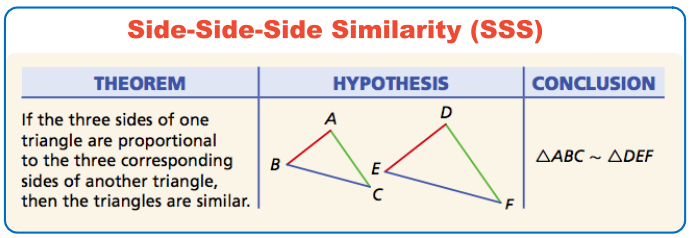
3. SSS (Side-Side-Side) Similarity Criterion
If in two triangles, sides of one triangle are proportional to the sides of the other triangle, then their corresponding angles are equal and hence the two triangles are similar.
Basic Proportionality Theorem (Thales Theorem)
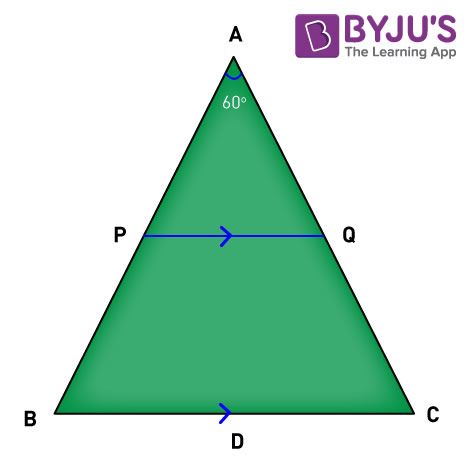
If a line is drawn parallel to one side of a triangle to intersect the other two sides in distinct points, the other two sides are divided in the same ratio.
Given: In ΔABC, DE || BC, intersecting AB at D and AC at E.
To Prove: AD/DB = AE/EC
Construction: Join BE and CD. Draw DM ⊥ AC and EN ⊥ AB.
| Statements | Reasons |
|---|---|
| 1. ar(ΔADE) = ½ × AD × EN | Area formula |
| 2. ar(ΔBDE) = ½ × DB × EN | Area formula |
| 3. ar(ΔADE)/ar(ΔBDE) = AD/DB | Dividing (1) by (2) |
| 4. ar(ΔADE) = ½ × AE × DM | Area formula |
| 5. ar(ΔCDE) = ½ × EC × DM | Area formula |
| 6. ar(ΔADE)/ar(ΔCDE) = AE/EC | Dividing (4) by (5) |
| 7. ar(ΔBDE) = ar(ΔCDE) | Same base DE, same parallels |
| 8. AD/DB = AE/EC | From (3), (6), (7) |
Hence Proved.
Converse of Basic Proportionality Theorem
If a line divides any two sides of a triangle in the same ratio, then the line is parallel to the third side.
Pythagoras Theorem
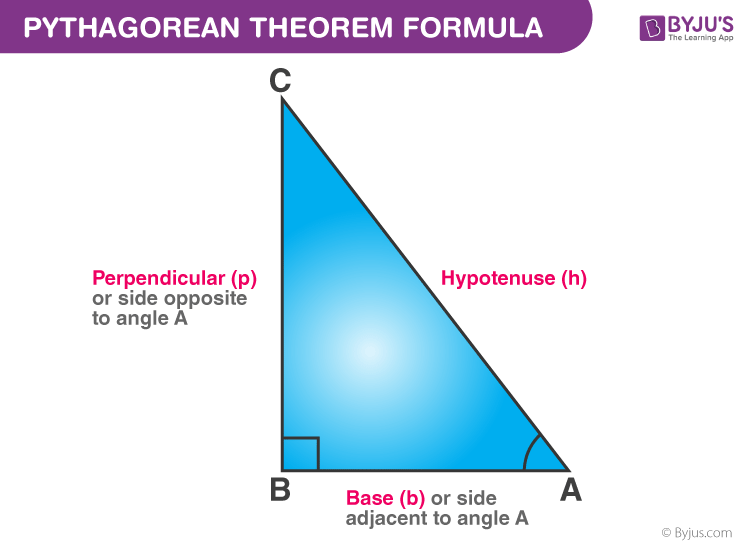
In a right-angled triangle, the square of the hypotenuse is equal to the sum of the squares of the other two sides.
Construction: Draw BD ⊥ AC
| Statements | Reasons |
|---|---|
| 1. ΔADB ~ ΔABC | AA similarity (∠A common, ∠ADB = ∠ABC = 90°) |
| 2. AD/AB = AB/AC | Corresponding sides proportional |
| 3. AB² = AD × AC ... (i) | Cross multiplication |
| 4. ΔBDC ~ ΔABC | AA similarity (∠C common, ∠BDC = ∠ABC = 90°) |
| 5. DC/BC = BC/AC | Corresponding sides proportional |
| 6. BC² = DC × AC ... (ii) | Cross multiplication |
| 7. AB² + BC² = AD×AC + DC×AC | Adding (i) and (ii) |
| 8. = AC(AD + DC) = AC × AC = AC² | Since AD + DC = AC |
Hence Proved: AC² = AB² + BC²
Converse of Pythagoras Theorem
In a triangle, if the square of one side is equal to the sum of the squares of the other two sides, then the angle opposite to the first side is a right angle.
Areas of Similar Triangles Theorem
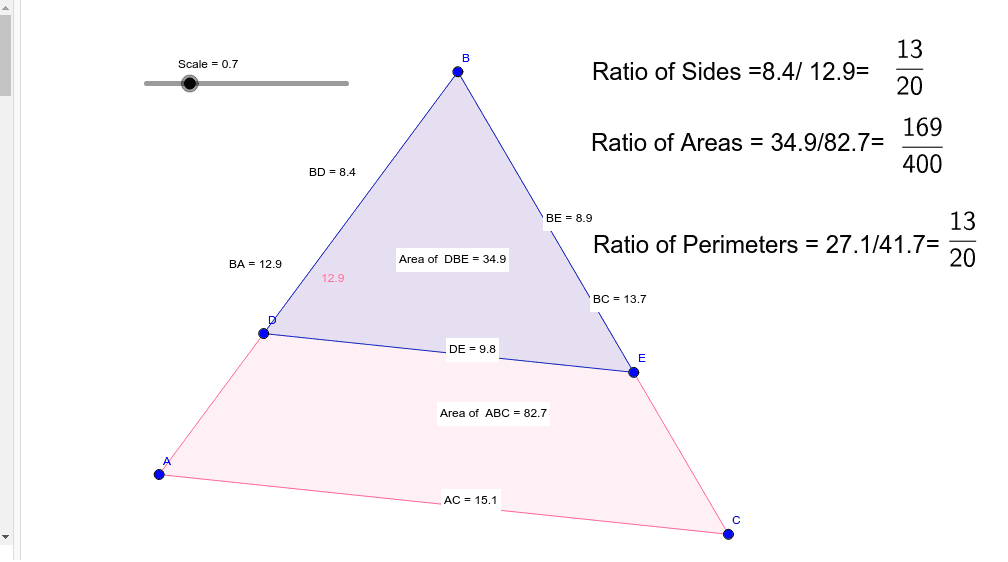
The ratio of the areas of two similar triangles is equal to the square of the ratio of their corresponding sides.
4. Important Theorems (Quick Reference)
🎯 Must-Know Theorems for CBSE Class 10 Maths Notes
| Theorem | When to Use | Key Formula |
|---|---|---|
| AAA Similarity | Two angles given equal | ∠A=∠D, ∠B=∠E ⇒ ΔABC ~ ΔDEF |
| SAS Similarity | One angle + adjacent sides | ∠A=∠D, AB/DE=AC/DF ⇒ Similar |
| SSS Similarity | All three sides given | AB/DE = BC/EF = CA/FD ⇒ Similar |
| BPT (Thales) | Parallel line in triangle | DE || BC ⇒ AD/DB = AE/EC |
| Converse BPT | To prove lines parallel | AD/DB = AE/EC ⇒ DE || BC |
| Pythagoras | Right triangle sides | H² = B² + P² |
| Area Theorem | Area of similar triangles | Ratio of areas = (Ratio of sides)² |
Memory Tips:
- AAA → All Angles Alike
- SAS → Side Angle Side (same order)
- SSS → Side Side Side (all three)
5. Solved Examples (CBSE Pattern)
By Basic Proportionality Theorem:
EC = (4.5 × 5)/3 = 22.5/3 = 7.5 cm
By Area Theorem:
ar(ΔDEF) = 20 × 4 = 80 cm²
To Prove: ar(ΔABC)/ar(ΔDEF) = AB²/DE²
Construction: Draw perpendiculars AL and DM to BC and EF.
Proof:
1. ar(ΔABC) = ½ × BC × AL
2. ar(ΔDEF) = ½ × EF × DM
3. Ratio = (BC × AL)/(EF × DM)
4. ΔALB ~ ΔDME (AA similarity)
5. AL/DM = AB/DE
6. Also AB/DE = BC/EF (given similar)
7. Therefore Ratio = (BC/EF) × (BC/EF) = BC²/EF² = AB²/DE²
Hence Proved.
By Pythagoras Theorem:
100 = 64 + BC²
BC² = 36
BC = 6 m
6. Smart Tricks Section
🚀 Quick Similarity Identification
Check vertex order carefully:
- ΔABC ~ ΔDEF means A↔D, B↔E, C↔F
- Corresponding sides: AB/DE = BC/EF = CA/FD
- Never mismatch the order—this is the #1 mistake!
🚀 Ratio Solving Shortcut
When AD/DB = 3/4 and AB = 14 cm, find AD:
- AD : DB = 3 : 4
- Total parts = 7
- AD = (3/7) × 14 = 6 cm
- DB = (4/7) × 14 = 8 cm
Cross-check: 6 + 8 = 14 ✓
🚀 Pythagoras Quick-Check
Memorize common Pythagorean Triplets:
- 3, 4, 5 (and multiples: 6, 8, 10)
- 5, 12, 13
- 8, 15, 17
- 7, 24, 25
- 9, 40, 41
See these numbers? Instantly identify the hypotenuse!
🚀 Diagram Labelling for Full Marks
Always label your diagram with:
- Given values (write actual numbers)
- What to find (mark with ?)
- Parallel lines (mark with arrows >>)
- Right angles (mark with square symbol ∟)
- Similar triangles (mark corresponding angles)
Examiners give marks for proper diagram!
🚀 Time-Saving Board Strategy
For 4-mark proof questions:
- Write Given, To Prove, Construction (1 mark)
- Draw neat diagram (1 mark)
- Write Statements and Reasons in columns (2 marks)
- End with "Hence Proved"
Never skip the "Reasons" column—CBSE mandates it!
7. Visual Learning
Similar Triangles - Proportional Sides
Basic Proportionality Theorem (Thales)
Right Triangle - Pythagoras Theorem
Areas of Similar Triangles
8. Most Important Board Questions
★ 1 Mark Questions
Ans: (2/3)² = 4/9
Ans: DB = 4 cm, so 2/4 = 3/EC ⇒ EC = 6 cm
Ans: If corresponding sides of two triangles are proportional, triangles are similar.
★★ 2-3 Mark Questions
Solution: ΔADE ~ ΔABC (AA similarity)
AD/AB = AE/AC ⇒ 3/8 = 4/AC ⇒ AC = 32/3 = 10.67 cm
Solution: ar₁/ar₂ = h₁²/h₂² ⇒ 81/49 = (13.5)²/h₂²
9/7 = 13.5/h₂ ⇒ h₂ = 10.5 cm
★★★ 4-5 Mark Proof Questions
Prove BPT: If a line is drawn parallel to one side of a triangle to intersect the other two sides in distinct points, the other two sides are divided in the same ratio.
Prove that the ratio of areas of two similar triangles equals the square of the ratio of their corresponding sides.
★★ Case Study Question
(i) Prove triangles formed are similar.
(ii) Find height of tower.
Solution:
(i) Both vertical (90° with ground). Sun's rays at same angle ⇒ AA similarity
(ii) h/20 = 5/12 ⇒ h = 8.33 m
9. Common Mistakes Students Make
❌ Incomplete Proof
Mistake: Writing only statements without reasons or skipping "Hence Proved"
Correction: Always write Statements | Reasons in parallel columns. End with "Hence Proved"
❌ Not Drawing Diagram
Mistake: Attempting geometry without diagram
Correction: Diagram is compulsory for full marks. Use pencil, draw neat, label all points.
❌ Ratio Calculation Mistakes
Mistake: Writing AD/AB = AE/EC instead of AD/DB = AE/EC in BPT
Correction: BPT states AD/DB = AE/EC (ratio of segments, not to whole side)
❌ Misapplying Similarity Criteria
Mistake: Using AAA when only sides given, or SSS when angles given
Correction:
- Angles given → Use AAA or SAS
- Sides given → Use SSS or SAS
- Parallel lines → Use BPT
10. Practice Section
MCQs
(a) 30° (b) 60° (c) 90° (d) 120°
Q2. In ΔABC, DE || BC and AD/DB = 3/5, then AE/AC equals:
(a) 3/5 (b) 3/8 (c) 5/8 (d) 5/3
Q3. Ratio of areas of two similar triangles is 16:25. Ratio of their corresponding sides is:
(a) 4:5 (b) 16:25 (c) 256:625 (d) 2:3
Answers: 1-(b), 2-(b), 3-(a)
Assertion-Reason
Assertion (A): If two triangles are congruent, then they are similar.
Reason (R): All congruent triangles have equal angles and proportional sides.
(a) Both true and R explains A
(b) Both true but R doesn't explain A
(c) A true but R false
(d) A false but R true
Answer: (a) Congruent triangles are similar with ratio 1:1
Case Study
(i) How far apart are they?
(ii) What theorem do you use?
Solution:
Distance₁ = 1500 km (north)
Distance₂ = 1800 km (west)
By Pythagoras: Distance = √(1500² + 1800²) = 2343 km
HOTS
Solution: Check: AC² = 144, AB² + BC² = 108 + 36 = 144
Since AC² = AB² + BC², by Converse of Pythagoras, ∠B = 90°
11. Frequently Asked Questions
Absolutely! Carries 6-8 marks. Includes compulsory proof-based questions like BPT and Pythagoras theorem that appear almost every year.
BPT (Basic Proportionality Theorem/Thales Theorem) and Pythagoras Theorem are most frequently asked. Their proofs appear almost every year in CBSE board exams.
Yes, 100%! Every theorem, proof, and example in these CBSE Class 10 Notes is strictly NCERT-aligned and perfect for board exam preparation.
- Master all 6 theorems with complete proofs
- Practice diagram-based questions daily
- Memorize similarity criteria perfectly
- Solve previous 5 years' papers
6-8 marks in CBSE Class 10 Mathematics board exam.
12. Conclusion
Mastering CBSE Class 10 Notes for Chapter 6 Triangles requires dedicated practice of theorems and applications. Remember:
- ✓ Theorems are your strength—learn proofs by heart
- ✓ Diagrams fetch marks—never skip drawing them
- ✓ NCERT is sufficient—master it before any reference book
- ✓ Time management—practice writing proofs within time limit
Revision Checklist:
- All 6 theorems with proofs
- BPT and converse applications
- Pythagoras and converse problems
- Area ratio calculations
- Previous year board questions
Next Topic: Coordinate Geometry – CBSE Class 10 Notes
Best of luck for your CBSE Class 10 Board Exams! 🎯
