
CBSE Class 10 Maths Notes – Chapter 7 Coordinate Geometry

1. Introduction
Welcome to the comprehensive CBSE Class 10 Notes for Chapter 7: Coordinate Geometry. These CBSE Class 10 Maths Notes are meticulously prepared by senior mathematics faculty to help you master one of the most scoring chapters in your board examination.
Coordinate Geometry (also called Analytical Geometry) is the marriage of algebra and geometry. It provides a powerful tool to solve geometric problems using algebraic methods by representing points as ordered pairs of numbers.
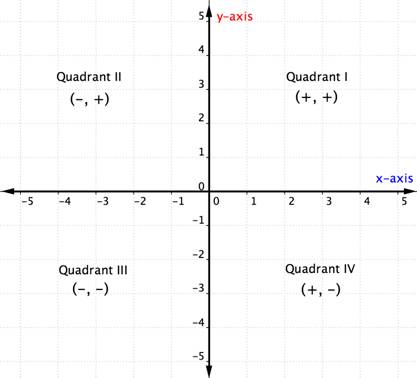
- Two perpendicular lines called X-axis (horizontal) and Y-axis (vertical)
- The intersection point is called Origin (0, 0)
- Any point P is represented as (x, y) where x is abscissa and y is ordinate
- The plane is divided into four quadrants
- High Weightage: Carries 4-6 marks in board exams
- Formula-Based: Easy to score if formulas are memorized correctly
- Foundation for Class 11-12: Essential for Straight Lines, Circles, and Conic Sections
- Real-World Applications: Used in GPS navigation, computer graphics, and engineering
These CBSE Class 10 Maths Notes follow the exact NCERT sequence and include every formula, derivation, and solved example prescribed by the CBSE syllabus.
2. Chapter Overview
| Aspect | Details |
|---|---|
| Topics Covered | Distance Formula, Section Formula, Area of Triangle, Condition of Collinearity, Applications |
| Marks Weightage | 4-6 marks (Board Exam) |
| Difficulty Level | Easy to Moderate (Calculation-based) |
| Question Types | MCQs, Short Answer (2-3 marks), Long Answer (4-5 marks) |
| NCERT Exercises | 7.1, 7.2, 7.3, 7.4 (Optional) |
3. Key Concepts (100% NCERT Accurate)
Distance Formula
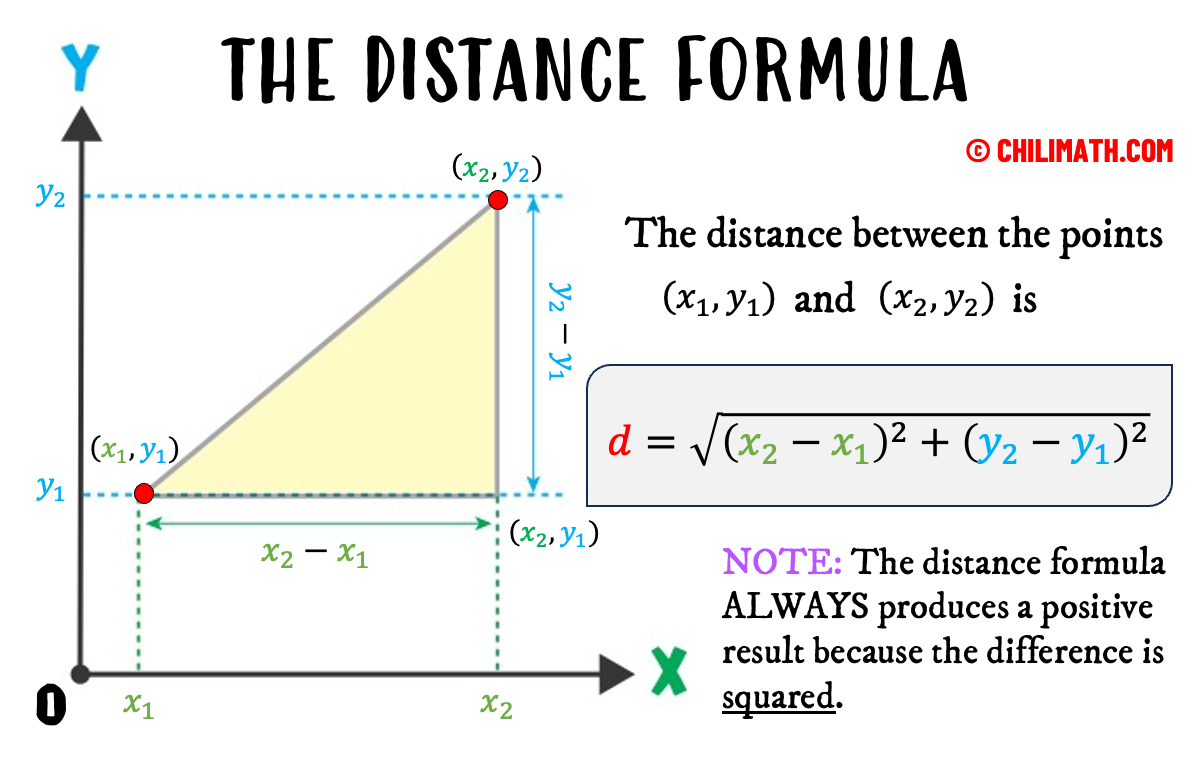
Statement: The distance between two points A(x₁, y₁) and B(x₂, y₂) is given by:
Derivation using Pythagoras Theorem:
Consider two points A(x₁, y₁) and B(x₂, y₂). Draw AC and BC parallel to axes forming right triangle ACB where ∠C = 90°.
- AC = |x₂ − x₁| (horizontal distance)
- BC = |y₂ − y₁| (vertical distance)
By Pythagoras Theorem:
Special Case: Distance from origin O(0,0) to point P(x,y):
Section Formula (Internal Division)
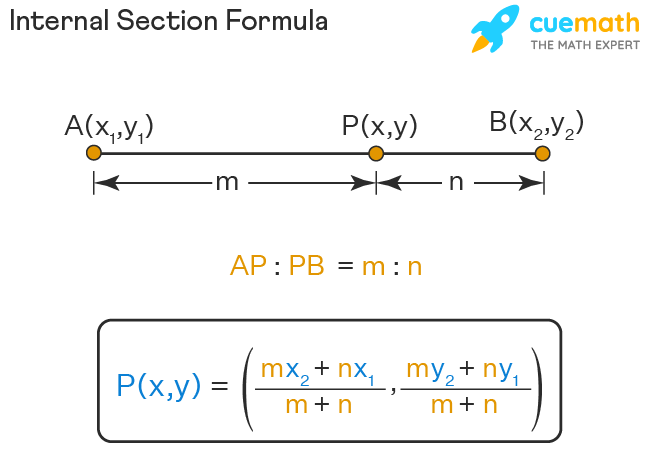
Statement: The coordinates of the point P(x, y) which divides the line segment joining A(x₁, y₁) and B(x₂, y₂) internally in the ratio m:n are:
Special Case – Midpoint Formula (when m:n = 1:1):
Area of Triangle Formula
The area of a triangle whose vertices are A(x₁, y₁), B(x₂, y₂), and C(x₃, y₃) is:
Important: The modulus sign | | ensures area is always positive.
Condition for Collinearity
Three points A, B, and C are collinear (lie on the same straight line) if:
4. Important Formulas (Quick Reference)
Must-Remember Formulas for CBSE Class 10 Maths Notes
| Formula | Expression | When to Use |
|---|---|---|
| Distance Formula | $\sqrt{(x_2-x_1)^2 + (y_2-y_1)^2}$ | Finding distance between two points |
| Distance from Origin | $\sqrt{x^2 + y^2}$ | When one point is (0,0) |
| Section Formula (Internal) | $x = \frac{mx_2+nx_1}{m+n}$ $y = \frac{my_2+ny_1}{m+n}$ |
Point divides segment internally in ratio m:n |
| Midpoint Formula | $\left(\frac{x_1+x_2}{2}, \frac{y_1+y_2}{2}\right)$ | Finding middle point of segment |
| Area of Triangle | $\frac{1}{2}\left|x_1(y_2-y_3) + x_2(y_3-y_1) + x_3(y_1-y_2)\right|$ | Area given three vertices |
| Collinearity Condition | Area = 0 | Checking if three points are collinear |
Memory Tips:
- Distance: "Square of difference in x plus square of difference in y, take square root"
- Section: "Opposite point gets multiplied by opposite ratio number"
- Area: "Cyclic order $x_1(y_2-y_3) + x_2(y_3-y_1) + x_3(y_1-y_2)$"
5. Solved Examples (CBSE Pattern)
Using Distance Formula:
$$AB = \sqrt{(5 - 2)^2 + (7 - 3)^2}$$ $$= \sqrt{3^2 + 4^2}$$ $$= \sqrt{9 + 16}$$ $$= \sqrt{25}$$ $$= \mathbf{5 \text{ units}}$$
Using Section Formula:
$$x = \frac{3 \times 8 + 1 \times 4}{3 + 1} = \frac{24 + 4}{4} = \frac{28}{4} = \mathbf{7}$$
$$y = \frac{3 \times 5 + 1 \times (-3)}{3 + 1} = \frac{15 - 3}{4} = \frac{12}{4} = \mathbf{3}$$
Answer: The required point is $\mathbf{(7, 3)}$
Using Area Formula:
$$= \frac{1}{2}\left| 2(5 - 1) + 4(1 - 3) + 6(3 - 5) \right|$$ $$= \frac{1}{2}\left| 2(4) + 4(-2) + 6(-2) \right|$$ $$= \frac{1}{2}\left| 8 - 8 - 12 \right|$$ $$= \frac{1}{2}\left| -12 \right|$$ $$= \frac{1}{2} \times 12$$ $$= \mathbf{6 \text{ square units}}$$
Three points are collinear if Area of triangle = 0
Using Area Formula:
$$= \frac{1}{2}\left| 1(1 - \sqrt{3}) + (-1)(\sqrt{3} - (-1)) + (-\sqrt{3})((-1) - 1) \right|$$ $$= \frac{1}{2}\left| 1 - \sqrt{3} - \sqrt{3} - 1 + 2\sqrt{3} \right|$$ $$= \frac{1}{2}\left| 0 \right|$$ $$= \mathbf{0}$$
Since Area = 0, the points are collinear. Hence Proved.
Let P divide AB in ratio $k:1$
Using Section Formula:
$$x = \frac{kx_2 + x_1}{k + 1}$$
$$-1 = \frac{k \times 6 + (-3)}{k + 1}$$ $$-1(k + 1) = 6k - 3$$ $$-k - 1 = 6k - 3$$ $$-7k = -2$$ $$k = \mathbf{\frac{2}{7}}$$
So the ratio is $\mathbf{2:7}$
Now finding $y$:
$$y = \frac{ky_2 + y_1}{k + 1} = \frac{\frac{2}{7} \times (-8) + 10}{\frac{2}{7} + 1}$$ $$= \frac{\frac{-16 + 70}{7}}{\frac{9}{7}}$$ $$= \frac{54}{7} \times \frac{7}{9}$$ $$= \mathbf{6}$$
Answer: Ratio = $\mathbf{2:7}$ and $y = \mathbf{6}$
6. Smart Tricks Section
Sign Management Trick
When calculating $(y_2 - y_1)$, always subtract in the SAME ORDER as $(x_2 - x_1)$.
Wrong: $x_2 - x_1 = 5 - 2 = 3$, but $y_1 - y_2 = 3 - 7 = -4$
Right: $x_2 - x_1 = 5 - 2 = 3$, and $y_2 - y_1 = 7 - 3 = 4$
Memory: "Same order, same sign pattern"
Quick Subtraction Trick
For distance formula, don't calculate differences mentally—write them:
- $(x_2 - x_1)$ = _____
- $(y_2 - y_1)$ = _____
Then square and add. This prevents silly sign errors!
Fast Collinearity Shortcut
Instead of full area formula, use:
If slopes are equal → points are collinear!
Example: Check if (1,2), (3,4), (5,6) are collinear
Slope AB = $\frac{4-2}{3-1} = 1$
Slope BC = $\frac{6-4}{5-3} = 1$
Equal slopes → Collinear!
Determinant-Style Memory Trick
For area formula, remember the cyclic pattern:
| x₁ | y₁ | 1 |
| x₂ | y₂ | 1 |
| x₃ | y₃ | 1 |
Cross multiply and add: $x_1y_2 + x_2y_3 + x_3y_1$
Cross multiply and subtract: $y_1x_2 + y_2x_3 + y_3x_1$
Area = $\frac{1}{2}|(\text{Sum 1}) - (\text{Sum 2})|$
🚀 Time-Saving Board Strategy
For 4-mark questions:
- Write the formula first (1 mark)
- Substitute values clearly (1 mark)
- Show calculation steps (1 mark)
- Final answer with units (1 mark)
Never skip writing the formula—examiners check for it specifically!
7. Visual Learning
Cartesian Plane with Points
Distance Between Two Points
Section Formula (Internal Division)
Area of Triangle

8. Most Important Board Questions
★ 1 Mark Questions
Ans: $\sqrt{3^2 + 4^2} = \sqrt{25} = \mathbf{5 \text{ units}}$
Ans: $\left(\frac{2+6}{2}, \frac{4+8}{2}\right) = \mathbf{(4, 6)}$
Ans: Using area formula: $\frac{1}{2}|2(k-3) + 4(3-3) + 6(3-k)| = 4$
Solve to get $k = \mathbf{1 \text{ or } 5}$
★★ 2-3 Mark Questions
Solution: Let point be $(x, 0)$
$(x-2)^2 + 25 = (x+2)^2 + 81$
Solve: $x = \mathbf{-7}$
Point: $\mathbf{(-7, 0)}$
Solution: Let ratio be $k:1$
x-coordinate on y-axis = 0
$0 = \frac{k(-1) + 5}{k + 1}$
$-k + 5 = 0 \Rightarrow k = 5$
Ratio = $\mathbf{5:1}$
★★★ 4-5 Mark Questions
Prove that the points (3, 0), (6, 4), and (-1, 3) are vertices of a right-angled isosceles triangle.
Let A(3,0), B(6,4), C(-1,3)
Calculate distances:
$AB = \sqrt{(6-3)^2 + (4-0)^2} = \sqrt{9+16} = 5$
$BC = \sqrt{(-1-6)^2 + (3-4)^2} = \sqrt{49+1} = \sqrt{50} = 5\sqrt{2}$
$CA = \sqrt{(3+1)^2 + (0-3)^2} = \sqrt{16+9} = 5$
Check: $AB^2 + CA^2 = 25 + 25 = 50 = BC^2$
$\therefore$ Right-angled at A (Pythagoras satisfied)
Also $AB = CA = 5$, so isosceles.
Hence Proved.
If A(-2, 1), B(a, 0), C(4, b), and D(1, 2) are vertices of a parallelogram, find a and b.
In parallelogram, diagonals bisect each other.
Midpoint of AC = Midpoint of BD
Midpoint of AC = $\left(\frac{-2+4}{2}, \frac{1+b}{2}\right) = \left(1, \frac{1+b}{2}\right)$
Midpoint of BD = $\left(\frac{a+1}{2}, \frac{0+2}{2}\right) = \left(\frac{a+1}{2}, 1\right)$
Equating:
$1 = \frac{a+1}{2} \Rightarrow a = \mathbf{1}$
$\frac{1+b}{2} = 1 \Rightarrow b = \mathbf{1}$
★★ Case Study Based Question (4 Marks)
(i) Find coordinates of the fountain.
(ii) Find its distance from corner D.
Solution:
(i) Let fountain be at P(x, y)
PA = PB = PC
From PA = PB: $x^2 + y^2 = (x-40)^2 + y^2$
$x^2 = x^2 - 80x + 1600$
$80x = 1600 \Rightarrow x = \mathbf{20}$
From PB = PC: $(x-40)^2 + y^2 = (x-40)^2 + (y-30)^2$
$y^2 = y^2 - 60y + 900$
$60y = 900 \Rightarrow y = \mathbf{15}$
Fountain at $\mathbf{(20, 15)}$
(ii) Distance from D(0, 30):
$PD = \sqrt{(20-0)^2 + (15-30)^2} = \sqrt{400 + 225} = \sqrt{625} = \mathbf{25 \text{ m}}$
9. Common Mistakes Students Make
Sign Errors
Mistake: Writing $(3 - (-5))$ as $3 - 5 = -2$ instead of $8$
Correction: Use brackets carefully:
- $(3 - (-5)) = (3 + 5) = 8$
- $(-3 - 5) = -8$
Rule: "Minus of minus is plus, minus of plus is minus"
Forgetting Modulus in Area Formula
Mistake: Writing Area = $\frac{1}{2}(\text{value})$ without $| |$
Correction: Area is always positive, so:
Even if calculation inside gives $-12$, area = $\frac{1}{2} \times 12 = 6$ (not $-6$)
Wrong Substitution in Section Formula
Mistake: Confusing which point is $(x_1, y_1)$ and which is $(x_2, y_2)$
Correction: Label clearly:
- A$(x_1, y_1)$ = first point given
- B$(x_2, y_2)$ = second point given
- Ratio $m:n$ means $m$ parts towards B, $n$ parts towards A
Memory: "$m$ is for the second point, $n$ is for the first point"
Calculation Mistakes
Mistake: $(-3)^2 = -9$ (wrong) instead of $9$ (correct)
Correction: Remember:
- $(-a)^2 = a^2$ (always positive)
- $-a^2 = -(a^2)$ (always negative)
- Square of any real number is non-negative
10. Practice Section
MCQs
(a) $\sqrt{a^2 + b^2}$ (b) $2\sqrt{a^2 + b^2}$ (c) $a + b$ (d) $a^2 + b^2$
Q2. The point (3, 0) lies on:
(a) I quadrant (b) II quadrant (c) X-axis (d) Y-axis
Q3. If (3, 4), (2, 5), and (1, k) are collinear, then k equals:
(a) 6 (b) 5 (c) 4 (d) 3
Answers: 1-(b), 2-(c), 3-(a)
Assertion-Reason
Assertion (A): The point (0, 5) lies on y-axis.
Reason (R): A point lies on y-axis if its x-coordinate is zero.
(a) Both A and R are true and R is the correct explanation of A
(b) Both A and R are true but R is not the correct explanation of A
(c) A is true but R is false
(d) A is false but R is true
Answer: (a) Both true and R explains A
Case Study
(i) Find distance of each aircraft from radar station.
(ii) Find distance between the two aircraft.
(iii) A third aircraft C is midway between A and B. Find its coordinates.
Solution:
(i) $OA = \sqrt{100^2 + 100^2} = \sqrt{20000} = \mathbf{100\sqrt{2} \approx 141.42 \text{ km}}$
$OB = \sqrt{200^2 + 50^2} = \sqrt{42500} = \mathbf{50\sqrt{17} \approx 206.16 \text{ km}}$
(ii) $AB = \sqrt{(200-100)^2 + (50-100)^2} = \sqrt{10000 + 2500} = \sqrt{12500} = \mathbf{50\sqrt{5} \approx 111.80 \text{ km}}$
(iii) $C = \left(\frac{100+200}{2}, \frac{100+50}{2}\right) = \mathbf{(150, 75)}$
HOTS
Let A(4,3), B(6,4), C(5,6), D(3,5)
Calculate all sides:
$AB = \sqrt{(6-4)^2 + (4-3)^2} = \sqrt{5}$
$BC = \sqrt{(5-6)^2 + (6-4)^2} = \sqrt{5}$
$CD = \sqrt{(3-5)^2 + (5-6)^2} = \sqrt{5}$
$DA = \sqrt{(4-3)^2 + (3-5)^2} = \sqrt{5}$
All sides equal $\checkmark$
Calculate diagonals:
$AC = \sqrt{(5-4)^2 + (6-3)^2} = \sqrt{10}$
$BD = \sqrt{(3-6)^2 + (5-4)^2} = \sqrt{10}$
Diagonals equal $\checkmark$
Since all sides equal and diagonals equal, ABCD is a square. Hence Proved.
11. Frequently Asked Questions
Yes! Coordinate Geometry is one of the most scoring chapters in CBSE Class 10 Maths Notes, carrying 4-6 marks. It is calculation-based and formula-driven, making it easy to score full marks with practice.
The Distance Formula is the most frequently used, appearing in almost every question. Section Formula and Area Formula are equally important for higher marks questions.
Absolutely! These CBSE Class 10 Notes are 100% aligned with NCERT Chapter 7 Coordinate Geometry. Every formula, derivation, and solved example follows the NCERT pattern preferred by CBSE board examiners.
- Always write the formula first
- Use brackets for negative numbers
- Check signs carefully (especially with negative coordinates)
- Verify your answer by reverse calculation
- Practice at least 50 numerical problems before exam
Chapter 7 Coordinate Geometry carries 4-6 marks in the CBSE Class 10 Mathematics board exam, typically including 1 one-mark, 1 two-mark, and 1 three-mark question.
12. Conclusion
Mastering CBSE Class 10 Notes for Chapter 7 Coordinate Geometry requires consistent practice and careful calculation. Remember:
- ✓ Formulas are your weapons—memorize them perfectly
- ✓ Practice makes perfect—solve at least 100 numerical problems
- ✓ NCERT is sufficient—master all examples and exercises
- ✓ Presentation matters—write formula, substitute, calculate, conclude
Revision Checklist:
- Distance Formula and its derivation
- Section Formula (internal division)
- Midpoint Formula
- Area of Triangle Formula
- Collinearity condition
- Previous year board questions (last 5 years)
Next Topic: Introduction to Trigonometry – CBSE Class 10 Notes
Best of luck for your CBSE Class 10 Board Exams! 🎯
